
 雷科技





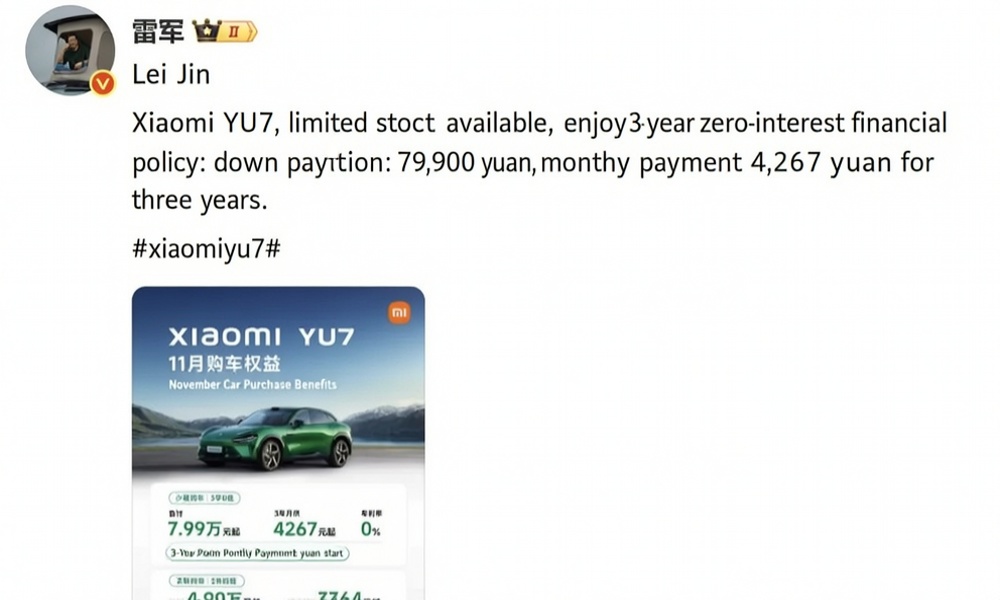

Folks, Lei Jun has once again trended on Weibo.
Mr. Lei posted a Weibo update announcing that the Xiaomi YU7 now offers special purchase incentives: 0% interest for three years, starting with a down payment of just RMB 79,900, and monthly installments of RMB 4,267 over three years.
RMB 79,900???
This post immediately topped Weibo’s trending list.

Image source: Screenshot from Weibo
This was originally just a routine promotional post—until Mr. Lei accidentally mistyped “down payment starting at RMB 79,900” as “down payment starting at RMB 7.99.”
LeiTech’s editorial team nearly dropped its phone in shock. What kind of magical pricing is this? Can you really drive home a brand-new all-electric SUV for the price of a bubble tea?
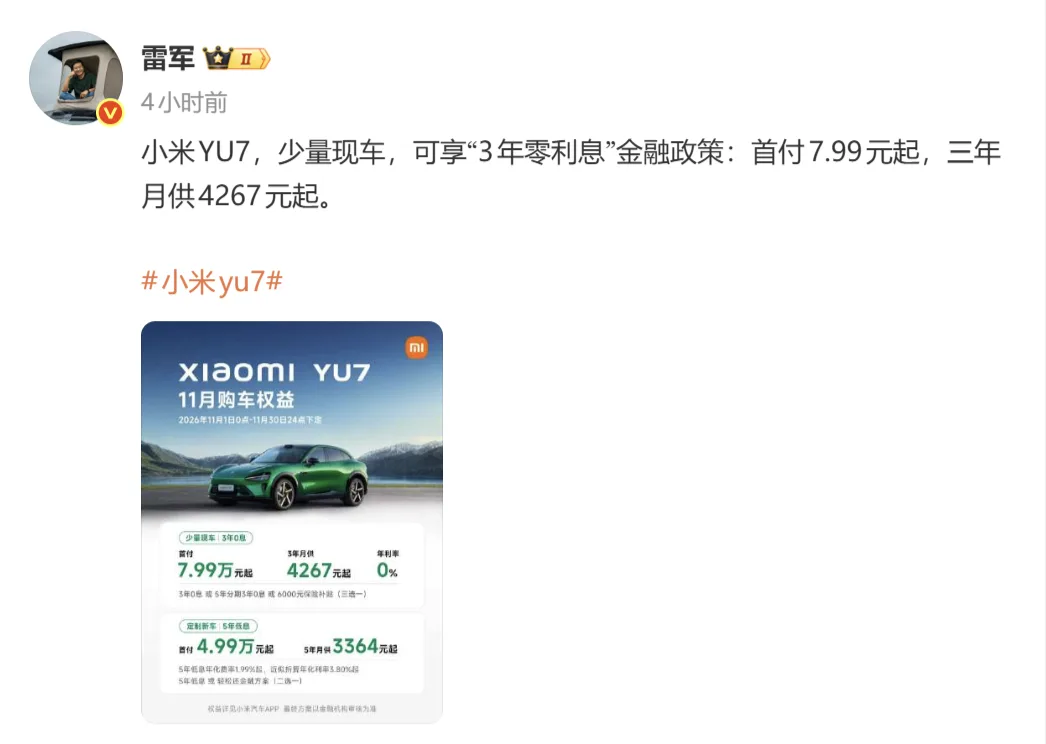
Image source: Screenshot from Weibo
Turns out, we weren’t the only ones thinking this way—the entire internet lined up in the comment section to claim their cars.
Some users joked, “One Weibo post from Mr. Lei slashed the car’s price to under RMB 10,” while others quipped, “RMB 7.99? Let’s head to the 4S store—I’ll take delivery right now; Mr. Lei has spoken!”
Others generously offered: “Here’s RMB 10—keep the change.”
About half an hour later, Mr. Lei noticed the error, promptly edited the original post, and added a clarification in the comments: the down payment starts at RMB 79,900.
To be fair, his response was refreshingly candid—no dodging or obfuscation.
Several netizens kindly reminded him in the comments: “Mr. Lei, please double-check your posts before hitting ‘send’ next time!”
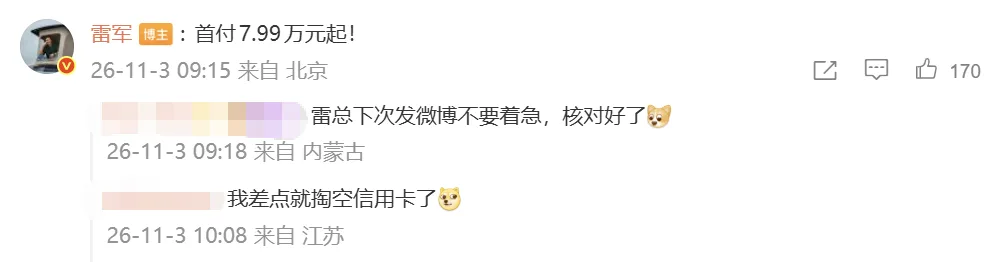
Image source: Screenshot from Weibo
While the joke is fun, let’s clarify the actual policy—so no one actually shows up at a dealership with RMB 8 in hand.
For orders placed between November 1 and November 30, select in-stock units of the Xiaomi YU7 qualify for a 3-year, 0% interest financing plan: a minimum down payment of RMB 79,900, followed by monthly payments of RMB 4,267 (or higher), with an annual interest rate of 0%. Buyers may choose among three financial options: (1) 3-year 0% interest, (2) 5-year installment plan with 0% interest for the first 3 years, or (3) RMB 6,000 insurance subsidy.
For those willing to wait for a custom-built vehicle, a 5-year low-interest option is also available: a minimum down payment of RMB 49,900, with monthly payments of RMB 3,364 (or higher) over five years.
So there you have it: “7.99” refers to ten-thousands of RMB—not yuan.
Interestingly, this isn’t the first time Mr. Lei has made such a slip-up within two days.
On November 2, he met in person with Zhou Yunjie, Chairman of Haier Group. Their joint appearance quickly earned them the playful nickname “Hai-Mi Brothers” among netizens.
Mr. Lei posted a Weibo thanking Mr. Zhou for his hospitality—and even gifted him a scale model of the SU7 Ultra. But when tagging him, he mistakenly tagged a different Weibo account named “Zhou Yunjie,” rather than Haier’s official account.
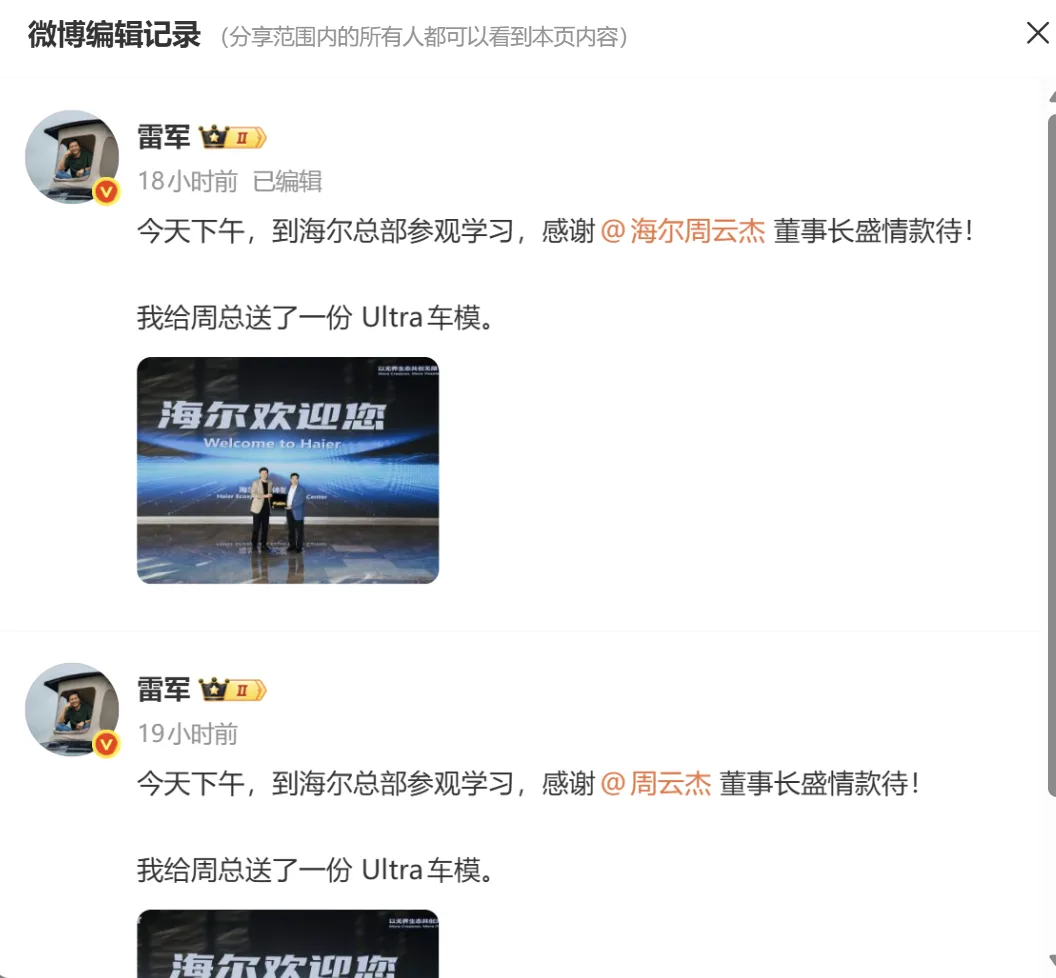
Image source: Screenshot from Weibo
Isn’t that ironic? Both errors appear trivial—but each landed on Weibo’s trending list.
An otherwise ordinary promotional message gained unprecedented exposure—far exceeding what any paid advertising campaign could deliver—thanks to a typo and a mis-tag.
As one netizen remarked: “Was this intentional? Clearly, he’s a master marketer.”
Honestly, LeiTech’s editor (ID: xiaoleibbb) believes this truly was an accidental slip. Everyone knows Mr. Lei’s work ethic—he posts dozens of Weibos daily and interacts with fans more frequently than even LeiTech’s own team. Typos are simply inevitable.
Yet, thanks to his massive fanbase and broad mainstream appeal, even minor blunders instantly generate comedic momentum—steering public discourse toward lighthearted memes rather than criticism.
This is what we call “persona-driven marketing leverage.” If the CEO of another brand had made the same pricing error, comments would likely have erupted with accusations of false advertising and demands for triple compensation. With Mr. Lei, however, the comments section reads like a live checkout queue: “We’re waiting—payment QR code ready!”
Doesn’t that just make you shake your head?
Amidst the laughter, though, Mr. Lei’s recent trending moment actually highlights something far more substantial: the YU7’s impressive residual value.
Consider this: The Tesla Model Y’s one-year residual value stands at 73.5%. The Xiaomi YU7 outperforms it by nearly nine percentage points. Meanwhile, the Li Auto i6 and NIO ES8 sit at 82.0% and 77.5%, respectively—meaning the YU7 ranks highest among them all.
Anyone familiar with new-energy vehicles knows how notoriously difficult it is to maintain strong residual values. Just two years ago, it was common for many emerging EV brands’ models to lose half their value after three years.
How long has the YU7 even been on the market? Achieving such a high residual value signals genuine confidence from the used-car market in the Xiaomi brand.
Mr. Lei himself shared the data on Weibo, adding a notable footnote: “The SU7’s one-year residual value is 74.9%—the highest among all pure-electric sedans.”
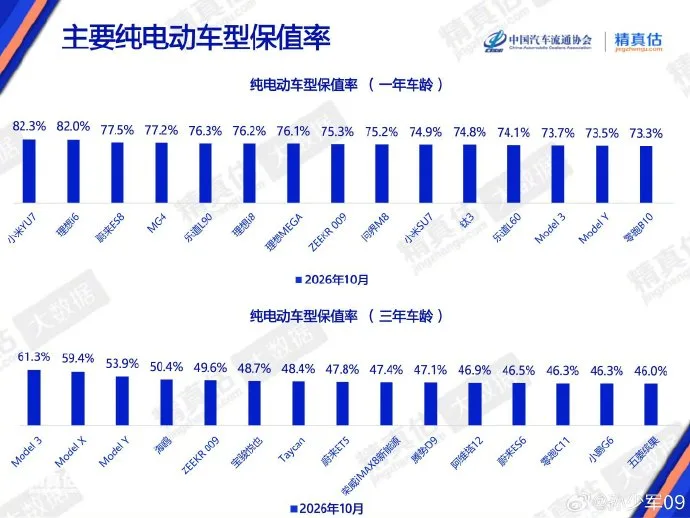
Image source: Weibo
So here we have it: one viral meme about RMB 7.99—and real-world validation in the form of an 82.3% residual value.
The former delivers a laugh; the latter delivers real peace of mind for buyers reaching into their wallets.
After scrolling through the comments, LeiTech’s biggest takeaway wasn’t how brilliant Mr. Lei’s marketing is—it was how strongly today’s netizens respond to authenticity and approachability.
A CEO of a publicly listed company who doesn’t put on airs, openly corrects mistakes, and jokes freely with fans in the comment section—that kind of genuineness resonates far more powerfully than a multi-million-dollar, high-production-value ad campaign.
When people buy a car, they’re not just buying hardware—they’re also buying the feeling that “this CEO is on my side.”
Of course, jokes aside: if you’re seriously considering purchasing a YU7, remember—the required down payment is RMB 79,900, not RMB 7.99. Don’t walk into a dealership waving RMB 8.20 from your WeChat balance—you’ll be the one left embarrassed, not Mr. Lei.
What do you think? Were Mr. Lei’s two recent slips genuine accidents—or deliberate moves? Share your thoughts in the comments below.