
 雷科技







On August 19, Unitree Robotics—the industry leader in robotics—listed on the Shanghai Stock Exchange at an issue price of RMB 150.8 per share. In its early trading days, Unitree’s market capitalization briefly surpassed RMB 440 billion, with its share price surging over sixfold from the offering price. However, the stock quickly retreated, and its market cap subsequently fell below RMB 170 billion.
Across the broader industry, this event appears to have marked a turning point for robotics companies rushing toward IPOs. Prior to Unitree’s listing, UBTECH was the first to list on the Hong Kong Stock Exchange; followed by Geek+, UFactory, SEER Robotics,珞石 (Luoshi Robotics), and numerous other robotics-related enterprises. Meanwhile, over 50 embodied AI companies—including DeepRobotics, Agibot, and Leju Intelligent—were preparing for IPOs.
Yet following Unitree’s IPO, the entire robotics industry has witnessed a paradox: companies are intensively preparing for IPOs but remain hesitant—or unable—to proceed to market.
The Capital-Burning Race Continues; IPOs Become a Lifeline
Embodied AI is a classic “capital guzzler.” Training large models, iterating hardware, expanding teams, and building production lines—all demand massive cash outlays. The problem is that most robotics OEMs have yet to achieve profitability. For example, UBTECH—which listed earlier—recorded total revenue of RMB 1.269 billion in the first half of this year, while reporting a net loss attributable to shareholders of RMB 311 million.
Today, most robotics companies are burning investors’ money—and once investors stop seeing returns, the company’s clock begins ticking down.
In July, Yinghe (Shenzhen) Robotics & Automation Co., Ltd.—having exhausted its RMB 600 million in financing—entered bankruptcy liquidation. In September, Zhicheng Dynamics (Suzhou) Co., Ltd. filed for bankruptcy reorganization. Numerous other small- and medium-sized robotics firms have similarly entered liquidation proceedings.
The primary driver pushing robotics companies toward IPOs is acute funding pressure. With tightening liquidity in the primary market, investors no longer write checks based solely on promising demos. Consequently, robotics firms must go public to raise capital and secure resources for ongoing software and hardware R&D.
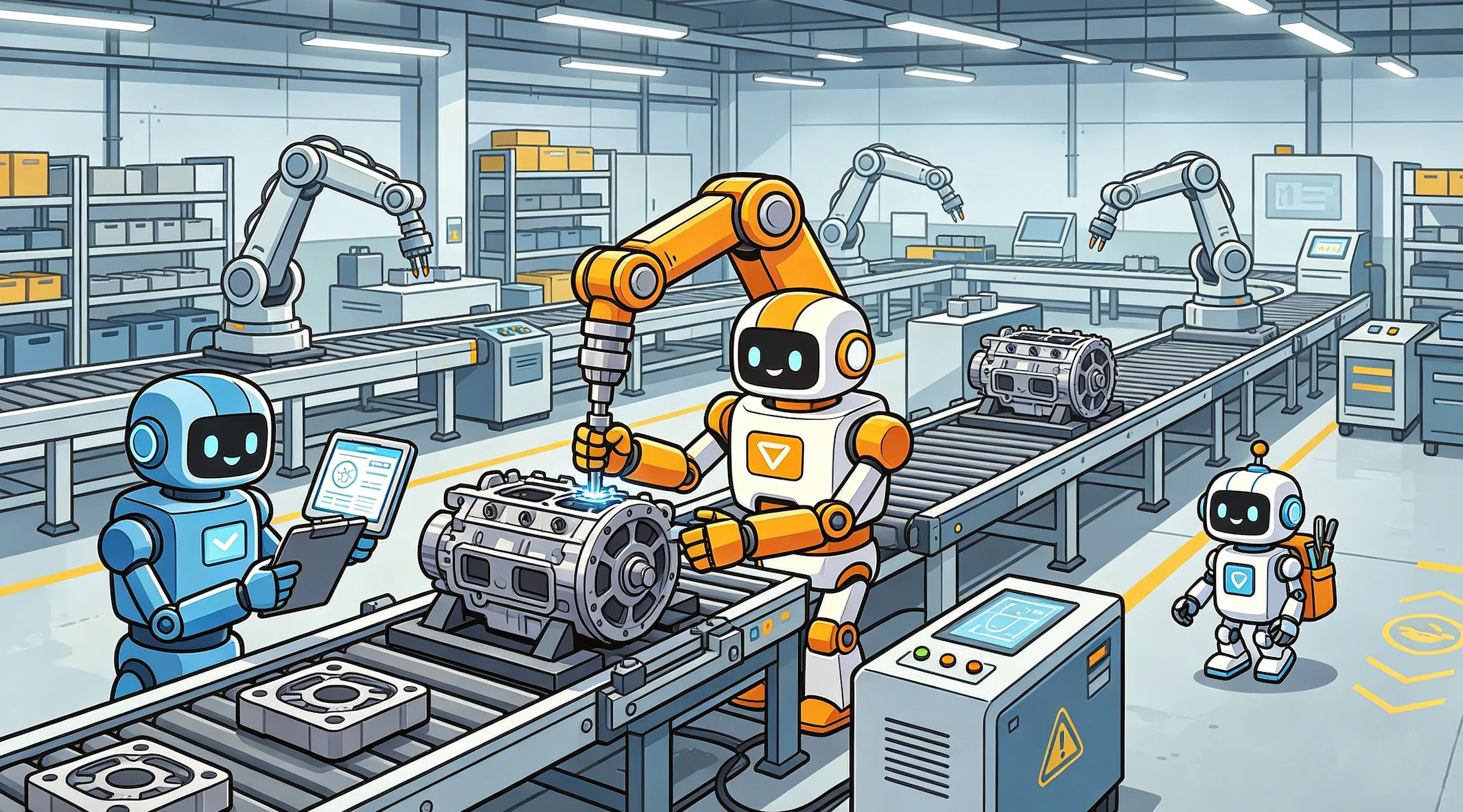
(Image source: Doubao AI generation)
Secondly, robotics companies have entered the commercialization phase, and the industry is now in a critical investment period focused on mass-production validation and closed-loop data collection. Production capacity for humanoid robots is expected to surge significantly between 2027 and 2029 among firms including Agibot, UBTECH, Unitree Robotics, Tesla, and XPeng.
Whoever secures investment first gains more capital to build production lines, refine cost-reduction curves, and accumulate real-world scenario data. Falling behind—even by a short margin—could widen the competitive gap. Many companies fear that, by the time commercialization reaches an inflection point, they’ll lack funds to scale up or capture key use cases—making it imperative to pursue IPOs promptly and stake their claim ahead of large-scale deployment.

(Image source: Doubao AI generation)
Third, investor pressure is mounting. According to Securities Times, secondary-market share transfers for some embodied AI companies over the past two months have traded at discounts ranging from 35% to 20% off their previous round valuations—but even at these steep discounts, buyers remain scarce. Tencent Technology further reported that recent secondary transactions have seen bids as low as 50% off prior valuations. Prolonged delays risk not only stalling valuation growth but triggering outright devaluation.
Additionally, embodied AI firms commonly grant equity incentives to executives, who naturally hope for an expedited IPO to convert their shares into liquid cash.
Rushing toward IPOs is, at its core, a survival decision shaped by the convergence of capital-cycle dynamics and strategic positioning. Going public serves both as a lifeline to fund R&D and as an exit channel for investors to realize returns—and for executives to monetize equity. Yet stark valuation gaps persist between primary and secondary markets; a hasty IPO offers no guarantee of success. Only those securing genuine orders and validating profitable business models can survive the industry’s inevitable shakeout.
Agibot Delays, Weiyi Pauses: Robotics IPOs Hit the Brakes
In early September—shortly after Unitree’s listing—technology media outlet The Information reported that regulators had informally instructed (via “window guidance”) a temporary pause on IPOs for certain humanoid robotics firms.
At the same time, Shao Tianlan, founder of recently listed Mech-Mind, publicly questioned peers on social media for inflating revenue via related-party transactions—selling robots at inflated prices to local state-owned data-collection centers, then repurchasing the resulting data at significant cost. He dubbed this practice “shuffling money from left hand to right hand,” and named a company valued above RMB 20 billion that is currently pursuing a Hong Kong listing.
The named firm responded with a statement asserting it would “refrain from pointless mudslinging,” stay “unswayed by short-term noise,” and remain focused on delivering superior products, solidifying real-world applications, and deepening technological capabilities.
Soon after, multiple IPO-bound firms reacted. On September 21, Huandong Technology withdrew its application for listing on the STAR Market. On September 30, Leju Intelligent—then awaiting approval on the Shenzhen Stock Exchange—paused its IPO process. On October 13, Agibot—long preparing for IPO—was reported to have launched a new financing round targeting RMB 1–1.5 billion at a RMB 5 billion valuation, while deferring its listing plans. Finally, on October 25, Weiyi Intelligent Manufacturing announced a delay in its global offering just three days before launch.
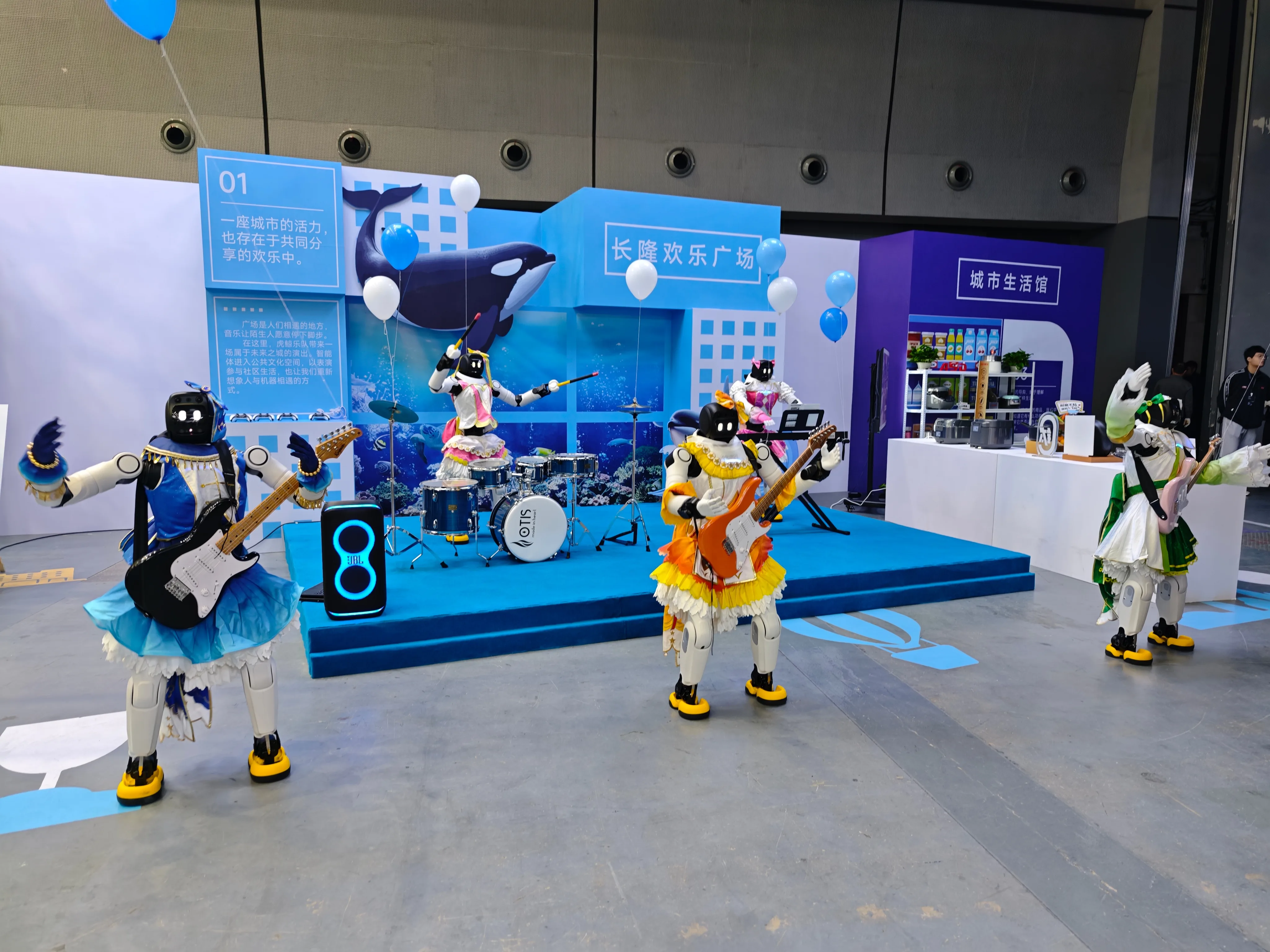
(Image source: LeiTech photography)
But has the robotics IPO wave truly cooled? LeiTech (ID: LeiTech) argues that while sector-wide enthusiasm has moderated and some firms have delayed timelines, the overall landscape remains vibrant—with numerous robotics companies—including YouAiZhiHe, JiaZhi Technology, and Chenxing Technology—still actively pursuing IPOs.
According to ITJuzi—a provider of internet startup investment data—the robotics sector raised RMB 124.51 billion in financing during the first eight months of 2026—already double the full-year 2025 total. Capital remains available in the primary market, albeit with stricter criteria; meanwhile, Unitree’s volatile market cap has effectively triggered a sector-wide repricing in the secondary market.
In its initial trading phase, Unitree’s peak market cap exceeded RMB 440 billion, before falling below RMB 170 billion. By market close on November 2, its market cap had rebounded to RMB 26.7824 billion, with its share price at RMB 662.17—still substantially above its IPO price.
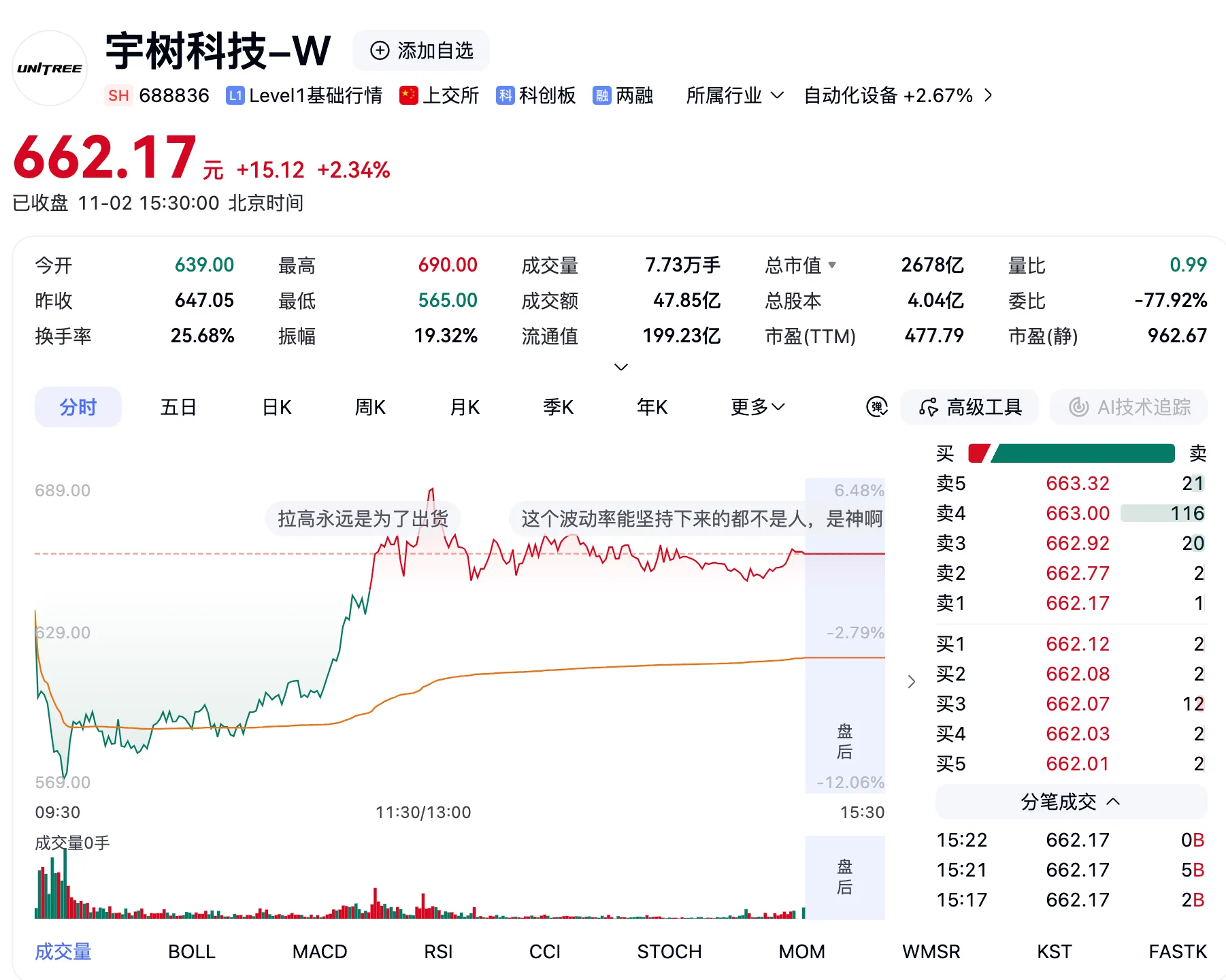
(Chart source: Baidu Stock Trading screenshot)
Unitree has grounded investor expectations for robotics firms in reality: valuations must first clear the hurdle of proven financial performance, and revenue quality matters. Even as an industry leader, Unitree derived 73.6% of its humanoid robot revenue in the first three quarters of 2025 from scientific research and education, while industry applications—including enterprise guidance, smart manufacturing, and intelligent inspection—accounted for only 9.01% combined.
Selling robots to labs versus selling them to factories tells two entirely different valuation stories. As Shao Tianlan alleged, if investors facilitate procurement and local industrial funds drive collaboration—including mutual data purchases—such practices could constitute fraud, warranting regulatory scrutiny.
Looking ahead, well-funded industry leaders will accelerate scenario-based deployment to demonstrate robots’ viability across diverse use cases, while undercapitalized players will continue pushing aggressively for IPOs to secure additional funding. Agibot exemplifies this strategy: after postponing its IPO, it rapidly unveiled new technologies and showcased its robots performing tasks such as flower arranging, clothing folding, smartphone charging, stool assembly, and phone packaging.
On November 2, Agibot launched its “Robots Must Keep Working” campaign, deploying its Jingling G2 robot to operate a 24-hour convenience store. By 2:30 p.m. that day, six Jingling G2 units had been on duty for 4.5 hours, completing 337 tasks cumulatively.
In the past, many embodied AI startups saw valuations balloon tenfold within a single year—yet made scant progress toward commercialization. Moving forward, competition will shift to real-world execution: the first company to validate sustainable gross margins in a single use case will earn its ticket to the next IPO round. Robotics IPOs haven’t cooled—they’ve simply grown more rational.
Robotics IPOs: Farewell to the “Storytelling Era”
During the early days of the new-energy vehicle (NEV) industry, numerous automakers pursued IPOs amid severe funding constraints—only to end up suspended or bankrupt, such as Fisker and Lordstown Motors. The robotics industry faces similar pressures: capital constraints compel firms to seek public listings.
Yet investors—having learned from the NEV sector—are markedly more cautious when evaluating robotics and embodied AI as a whole. Previously, investors paid premiums for the “humanoid robot” concept far exceeding its underlying commercial value. Today, prototype unveilings alone can no longer sustain valuations. Only robots that sell reliably, generate repeat orders, and deliver demonstrable unit economics merit ringing the bell.
Agibot’s IPO postponement does not signal abandonment of capital markets—it reflects a strategic understanding that launching prematurely during a valuation correction phase invites intense market scrutiny and exposes fundamental weaknesses. Instead, it is biding its time for a more favorable IPO window.
For financially constrained—or even insolvent—firms, rather than waiting for liquidation or restructuring, the better course is to proactively explore compliant pathways including corporate reorganization, M&A, or IPO—seizing any viable lifeline.