
 雷科技






On October 28, news broke that veteran financial commentator Qin Shuo published an article claiming China’s internet has entered the "ByteDance Time". Li Liang, Vice President of Douyin Group, responded to the claim, sparking heated discussion among netizens.
Today, let’s break this down in detail.
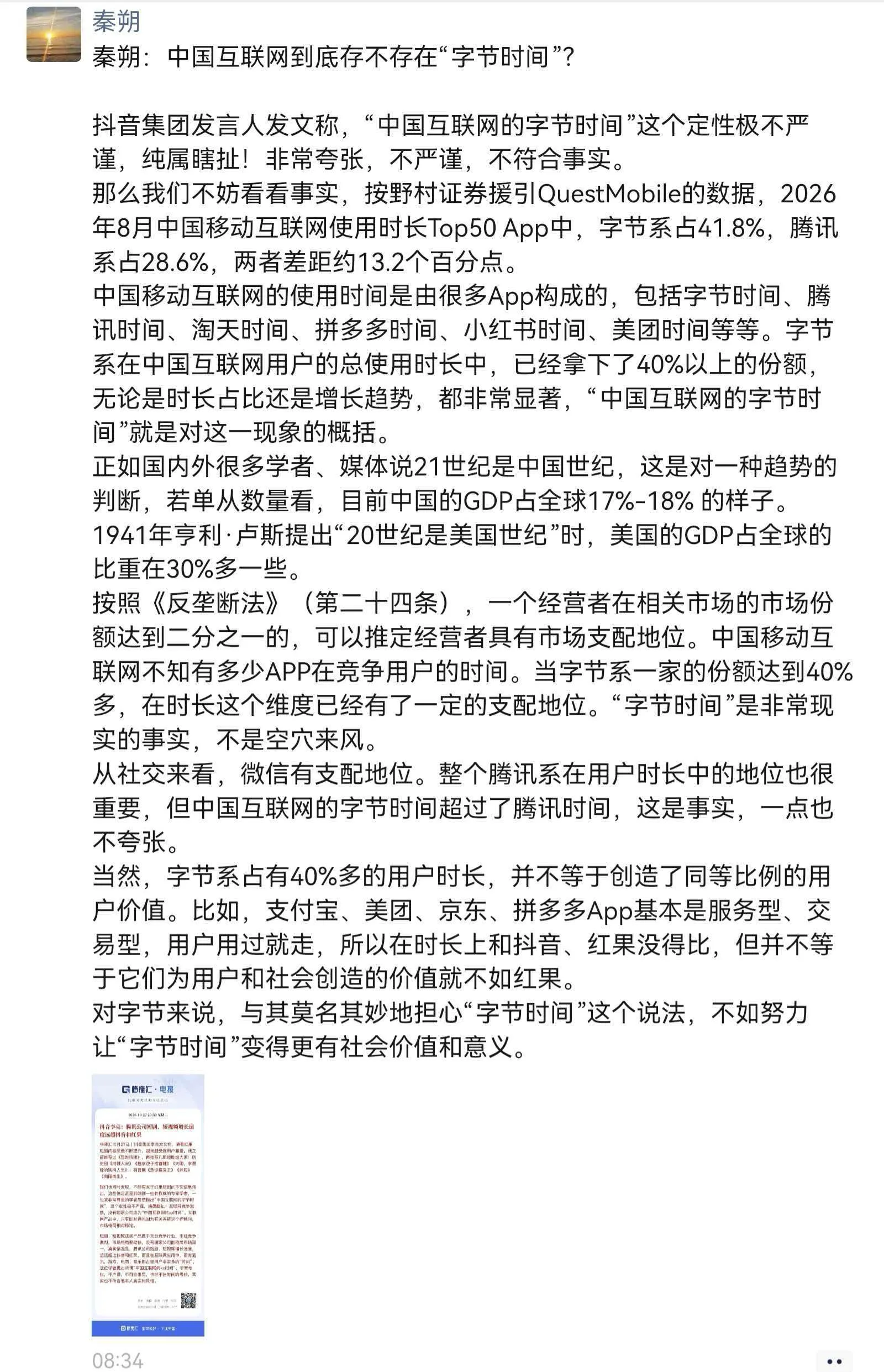
The story began when Qin Shuo published a recent article citing data from Nomura Securities, stating that in August 2026, ByteDance-owned apps accounted for 41.8% of total usage time among the top 50 mobile apps in China.
Source: Weibo
At first glance, this figure is certainly striking.
To bolster his "ByteDance Time" argument, Qin also referenced China’s Anti-Monopoly Law. He noted that while a 50% market share is the statutory threshold for presuming market dominance, a figure as high as 41.8% already points to a clear trend.
But no sooner had this label been applied than Douyin pushed back directly.
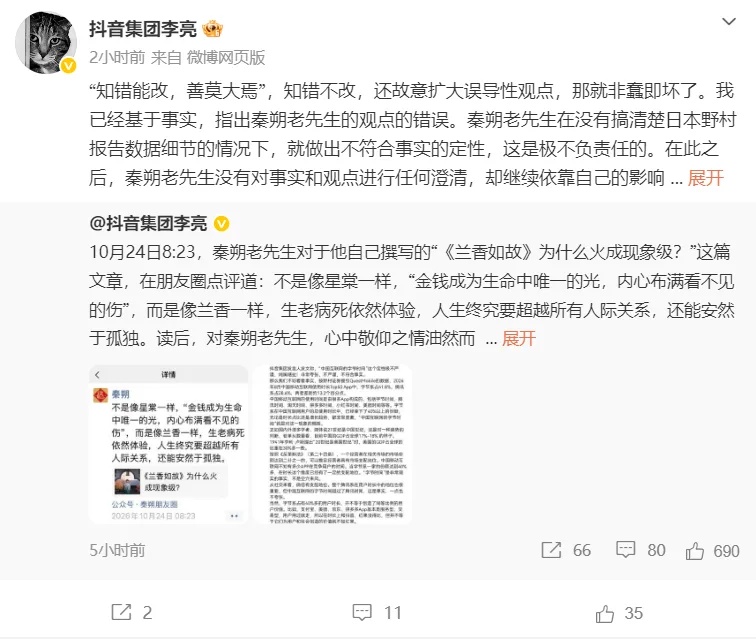
Li Liang, Vice President of Douyin Group, issued a response shortly after:
Source: Weibo
First, he pointed out flaws in the statistical scope. Nomura’s data only covers usage time distribution among the top 50 mobile apps, excluding tens of thousands of long-tail apps and desktop internet usage.
In our view, this is ByteDance’s share among top-tier apps, not "ByteDance Time" across China’s entire internet — the two are not the same thing. Drawing a conclusion about the whole internet landscape based solely on this figure is rather hasty.
Second, short dramas and short-form video are highly competitive tracks where no player can hold the top spot indefinitely. Among internet products, only instant messaging maintains a stable landscape thanks to its social graph moat. For short dramas and short-form video, frequent shifts in market leadership are the norm. What’s more, Tencent’s short drama and short video businesses are currently growing far faster than Douyin and Hongguo.
Finally, under the Anti-Monopoly Law, a company is only presumed to have market dominance when its market share reaches 50%. 41.8% does not even meet the statutory threshold. By this logic, China’s internet would have entered "Tencent Time" long ago — and stayed there for 20 years.
Drawing conclusions without clarifying the data details is irresponsible in itself, and spreading misleading views is either ignorant or malicious.
From the perspective of Xiaolei Bibibi (ID: xiaoleibbb), Qin Shuo’s logic — "strong ByteDance apps → more ByteDance usage time → higher market dominance" — simply does not hold water. Why?
Think about it: one person spends three hours mindlessly scrolling through short dramas on the couch, and an evening is gone. Another person opens Alipay for three minutes to transfer millions of yuan in payment for goods to a corporate account. Someone else opens Meituan for five minutes to book a banquet dinner costing thousands of yuan. Yet another opens Ctrip for ten minutes to finalize a business trip worth tens of thousands of yuan.
Source: Weibo
Can you say those three hours of entertainment time have higher commercial value than those few minutes of transactional usage? Obviously not.
User time across different scenarios generates vastly different commercial value. Time-killing entertainment usage and problem-solving utility usage are simply not on the same level.
Xiaolei Bibibi (ID: xiaoleibbb) offers another example. On iQiyi, Youku, Tencent Video and Bilibili, users spend dozens of hours immersed in TV series with highly focused attention — this is the deep engagement time of long-form video.
For hardware makers like Huawei, Xiaomi, OPPO, vivo and Apple, system services run from morning to night, with calls, notifications and app stores operating at the underlying level — this is hardware-level foundational time.
For Amap and Baidu Maps, drivers keep the apps open as soon as they hit the road, using them for the entire duration of their trip — this is indispensable time for mobility scenarios.
Not to mention the current AI boom, where various AI agents process information and execute tasks in the background 24/7. This can’t even be measured as "active user usage time" — does that mean it has no value?
Therefore, reducing the complexity of internet competition to a simple "app usage time ranking" is inherently a cognitive misconception.
The essence of the internet is services — solving users’ diverse needs across different scenarios.
All in all: do you think user usage time reflects an internet company’s real strength and market position? Feel free to share your thoughts in the comments and let’s discuss.

