
 雷科技






Human forgetfulness begins the very moment we jot something down.
When your car insurance expires, the follow-up date on your parents’ health reports, registration forms due at the end of the month, those quietly recurring subscription fees charged every month… none of these are particularly complicated tasks, yet some always slip our minds.
Yet, in the near future, such mundane, fragmented daily tasks may be fully entrusted to AI with confidence.
On October 27, Ant Group officially launched Lingguang 2.0 — the most significant upgrade since the product’s debut, and China’s first personal AI agent released by a major tech company. First launched last November, Lingguang initially gained traction by generating flash apps with a single voice command. This time, it aims to tackle a far more ambitious goal: evolving AI from a question-and-answer tool that completes one-off tasks into a long-term steward of personal affairs.
That is the most noteworthy breakthrough of Lingguang 2.0.
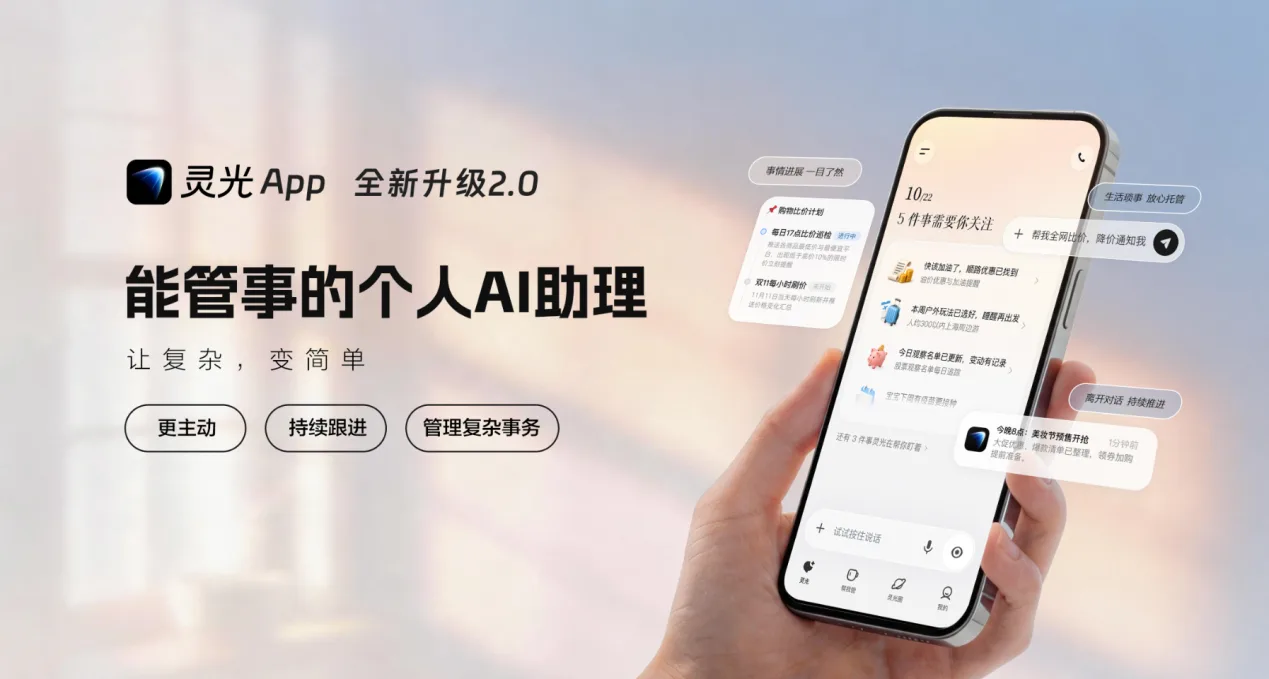
As AI gains longer memory, sustained execution capabilities and the ability to call on different apps and services, personal agents are evolving from obedient tools into proactive assistants that manage daily affairs.
AI Assistants Evolve: From Reactive Q&A to Proactive Task Management
Don’t assume using AI comes with no learning curve. With traditional AI, you first have to identify the problem, figure out exactly what you want, then instruct it to act. Take “look up flight tickets for me” as an example: after checking prices, there are always follow-up steps like booking and itinerary planning — yet conventional AI never proceeds to the next step on its own. It only answers what you ask, nothing more.
Lingguang 2.0 sets out to change this pattern.
According to official details, with user authorization, Lingguang can proactively identify potential needs by drawing on connected information and services, then analyze, monitor and follow up on tasks. Tasks continue running even after the user exits the conversation; when relevant information changes, it adjusts its handling accordingly and alerts the user when necessary.
The most critical shift here is that tasks no longer end when the chat window is closed.
Take flight tickets as an example: checking fares is just the first step of travel preparation. After booking a ticket, users may still care about price drops or itinerary adjustments. Traditional chat-based AI requires users to start a new conversation each time, but Lingguang 2.0 integrates all subsequent follow-ups into the same task.
There are countless similar use cases. With authorized access to Alipay, Lingguang can sort through spending bills and flag easily forgotten auto-renewing subscriptions. In family scenarios, it can organize teacher announcements from DingTalk class groups and extract key items and deadlines. For long-term reminders such as pet care, children’s vaccination schedules, family anniversaries and vehicle annual inspections, it can identify key milestones and follow up within the scope of user authorization.
Put simply, it remembers, monitors and delivers — evolving from a “task executor” into an “affairs manager”.
Second, Lingguang 2.0 now operates across a time dimension. It remembers commitments spanning days, weeks or even months, and keeps working after you close the conversation, adjusting plans when circumstances change. Where previous AI dealt with the present, Lingguang 2.0 helps plan for the future.
To achieve this, Lingguang 2.0 has upgraded its cross-session memory, long-term task scheduling and tool connectivity capabilities, with dedicated cloud servers supporting continuous task operation.
It also connects to services including Alipay bills, memberships and travel bookings, plus DingTalk, Lark, email and Mijia smart home systems, and supports calling tools such as MCP and CLI in open environments.
These capabilities determine whether Lingguang can connect information across different apps. For users, however, technical jargon doesn’t matter — what counts is whether the tasks they hand off get consistent follow-through.
Putting Lingguang 2.0 to Work: From Multi-Platform Analysis to Travel Planning
A good personal agent cannot be judged solely by its ability to understand a single instruction. What matters more is whether it can keep advancing tasks that require sustained execution, multiple steps, or even calls to different applications.
We tested three daily scenarios to observe the practical value of Lingguang 2.0’s capabilities.
Scenario 1: Multi-platform analysis, monitoring and follow-up
Suppose you have your eye on an iPhone DUO but aren’t ready to buy yet. What you really need isn’t another rundown of specs or a one-time price search across platforms — you want it to keep an eye on price changes for you.
So we set this task: “Track price markups on the iPhone DUO. Alert me when units are available at original retail price, and check roughly every two hours.”
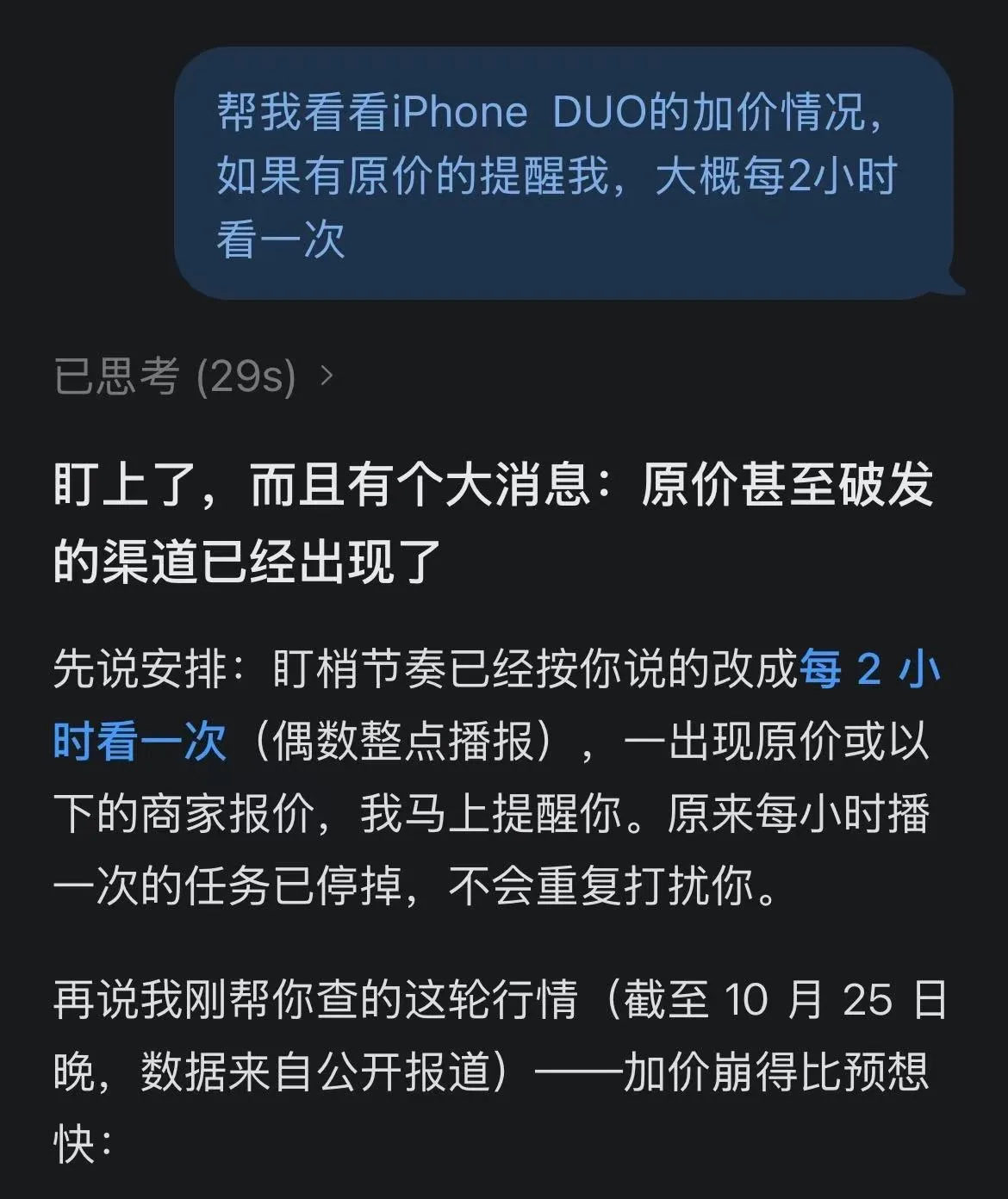
Lingguang’s execution far exceeded our expectations.
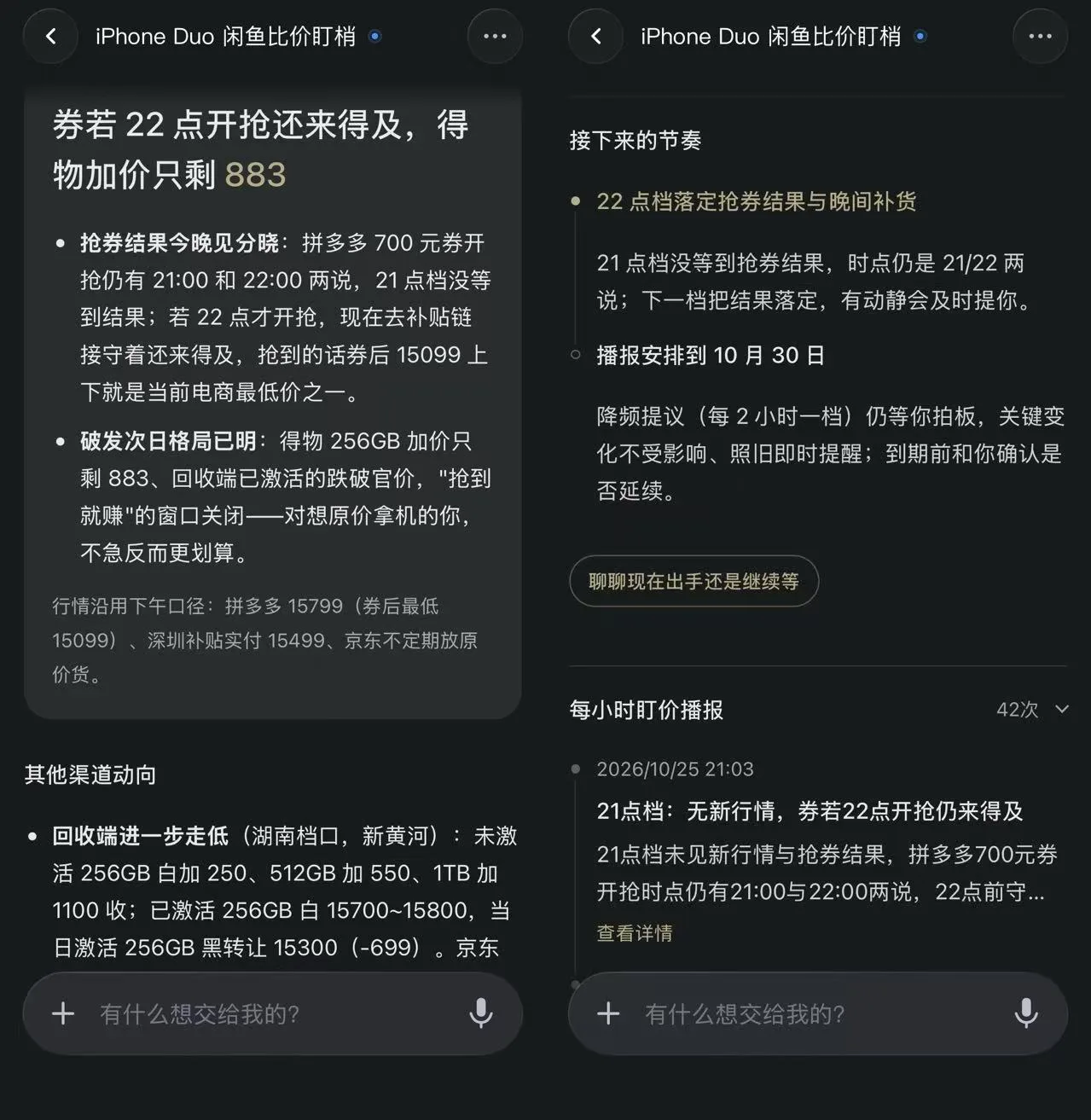
Beyond sending price-drop alerts, it notified us when coupon grabs would go live on each e-commerce platform, listed the exact markup rates, and added a thoughtful note: “Activated units on the resale market have already dropped below official price. The window for quick flipping profits is closed — if you want one at original price, waiting patiently is the smarter move.”
It didn’t just collect prices from official channels, either. It compiled prices from offline retail stalls and Hainan duty-free shops, sorted by storage capacity and color. It even included off-market insights, such as a dealer in Zhengzhou clearing 50 units at a total floating loss of 25,000 yuan.
Finally, it outlined the upcoming timeline — such as 10 PM coupon results and evening restocks — demonstrating genuinely robust functionality.
Scenario 2: Cross-platform collaboration
For frequent business travelers, one of the biggest hassles isn’t the trip itself, but sorting out reimbursement paperwork afterward.
Transportation, hotels, meals — scattered expenses spread across different dates. After a trip, you have to dig back through records, verify amounts and organize everything. With multiple trips a month, this chore easily gets put off.
Now there’s another approach: set Lingguang a recurring task to automatically compile last month’s Alipay business travel bills on the 1st of every month.
Since it wasn’t yet the 1st, we ran it manually. To our surprise, beyond pulling Alipay bills, Lingguang could even distinguish which expenses were business-related — flights, hotels, taxi rides — and categorize them clearly. It also added that if any taxi rides were personal, we could just let it know and it would recalculate.
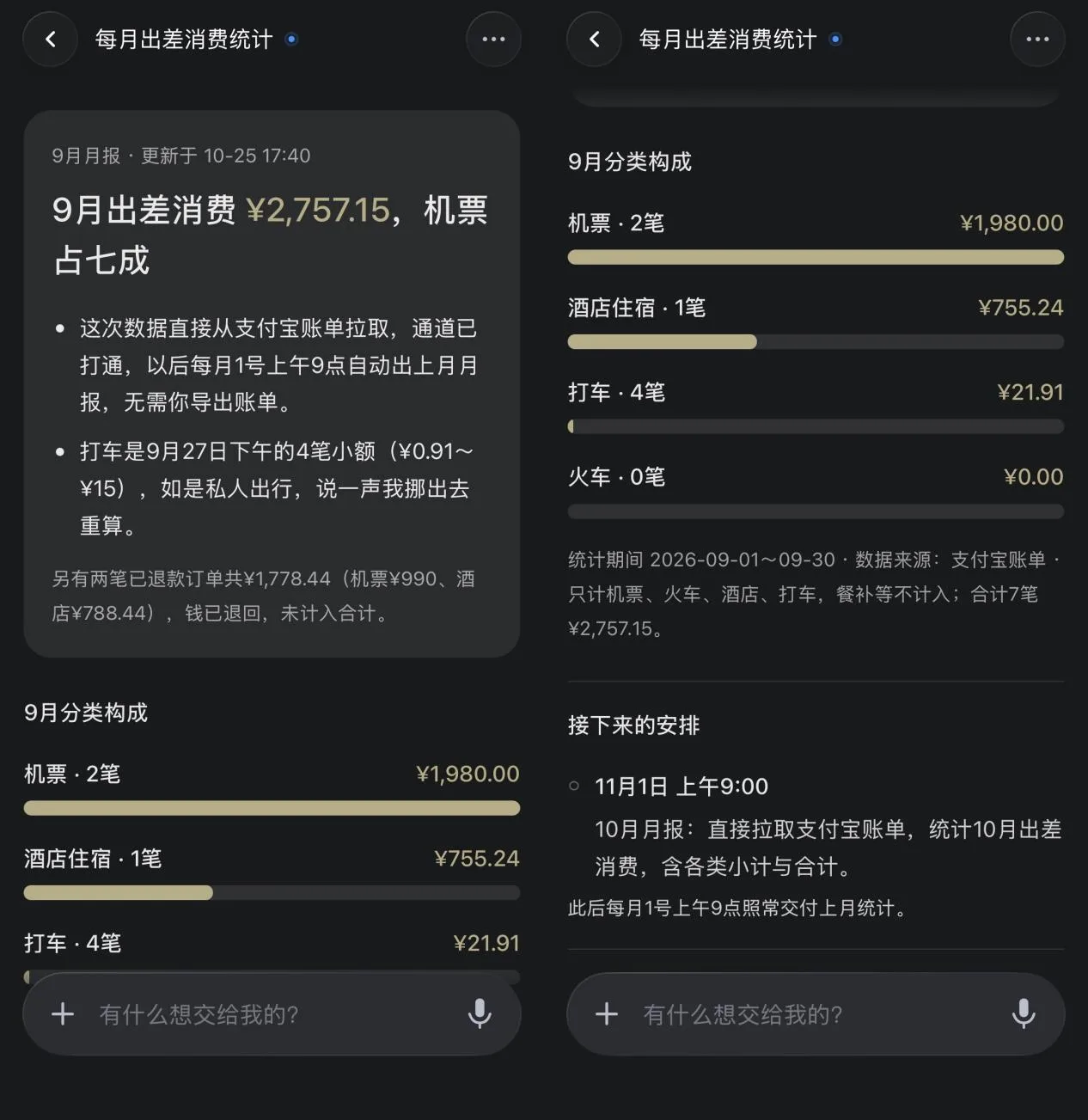
Taking the idea further: could Lingguang turn repetitive, easily procrastinated monthly work into scheduled automated tasks? For example, HR could simply upload employee reimbursement forms to DingTalk or Lark, then let Lingguang compile them at a fixed time. It seems well worth trying — it would drastically cut time spent on repetitive work.
Scenario 3: Continuous follow-up and chained task execution
If shopping and bill management test an AI’s sustained follow-up ability, concert travel planning tests whether it can link a whole chain of related tasks together.
So we set this task: “Keep an eye on Jay Chou’s concert tour. Check for official announcements and ticket news. Alert me when tickets go on sale, when restocks happen, when extra shows are added or dates change. After I get tickets, help plan my trip to the show.”
So we set this task: “Keep an eye on Jay Chou’s concert tour. Check for official announcements and ticket news. Alert me when tickets go on sale, when restocks happen, when extra shows are added or dates change. After I get tickets, help plan my trip to the show.”
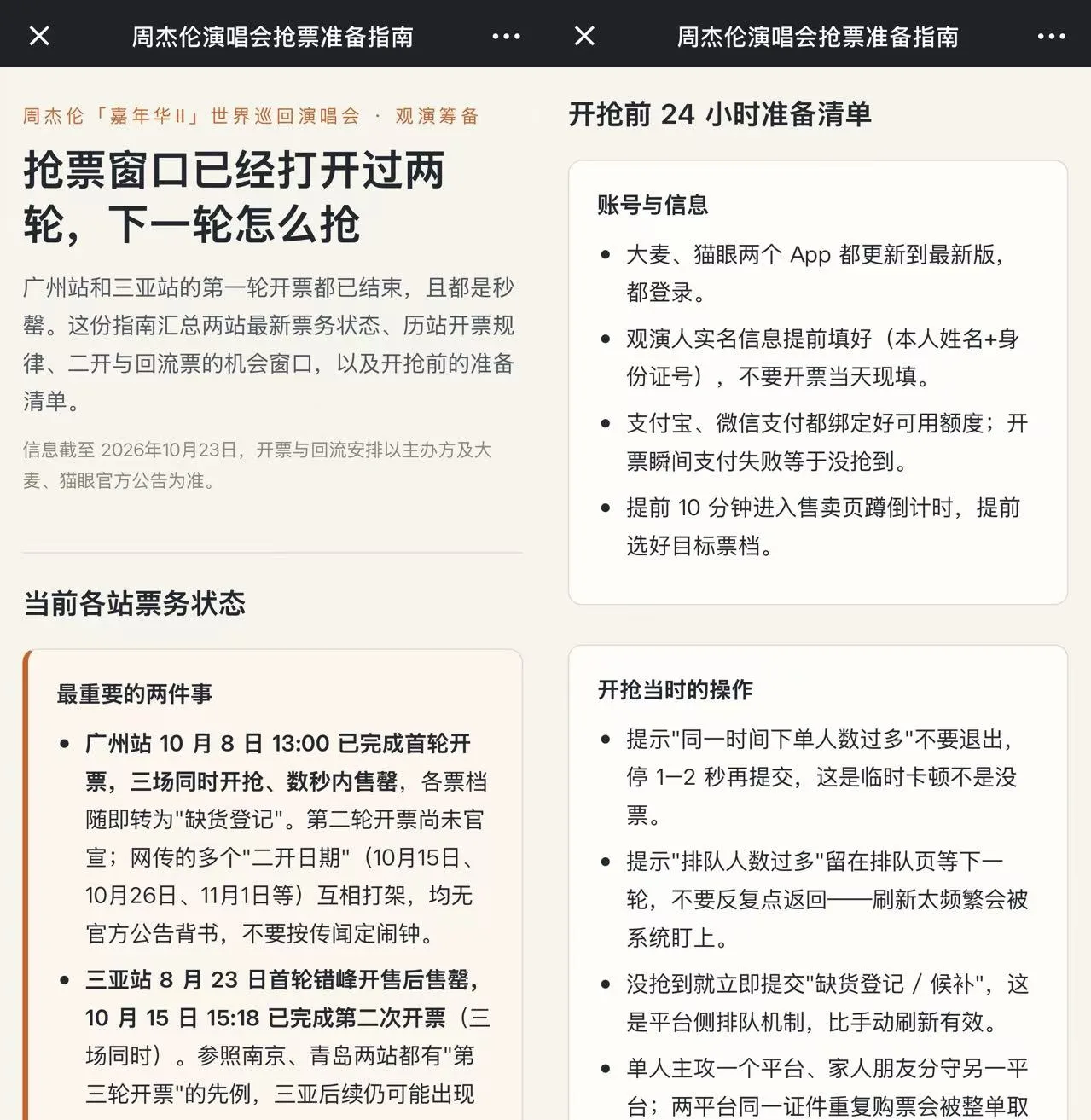
We then simulated having secured tickets to the Guangzhou show to see what Lingguang would do next.
First, it confirmed transportation options: based on the seat section on the ticket, it recommended the nearest entrance. For out-of-town attendees, it suggested arriving at Guangzhou East Station and taking the subway; for drivers, it recommended the best parking lots. It also offered time-saving and comfort-focused tips for after the show ends — all genuinely useful advice.
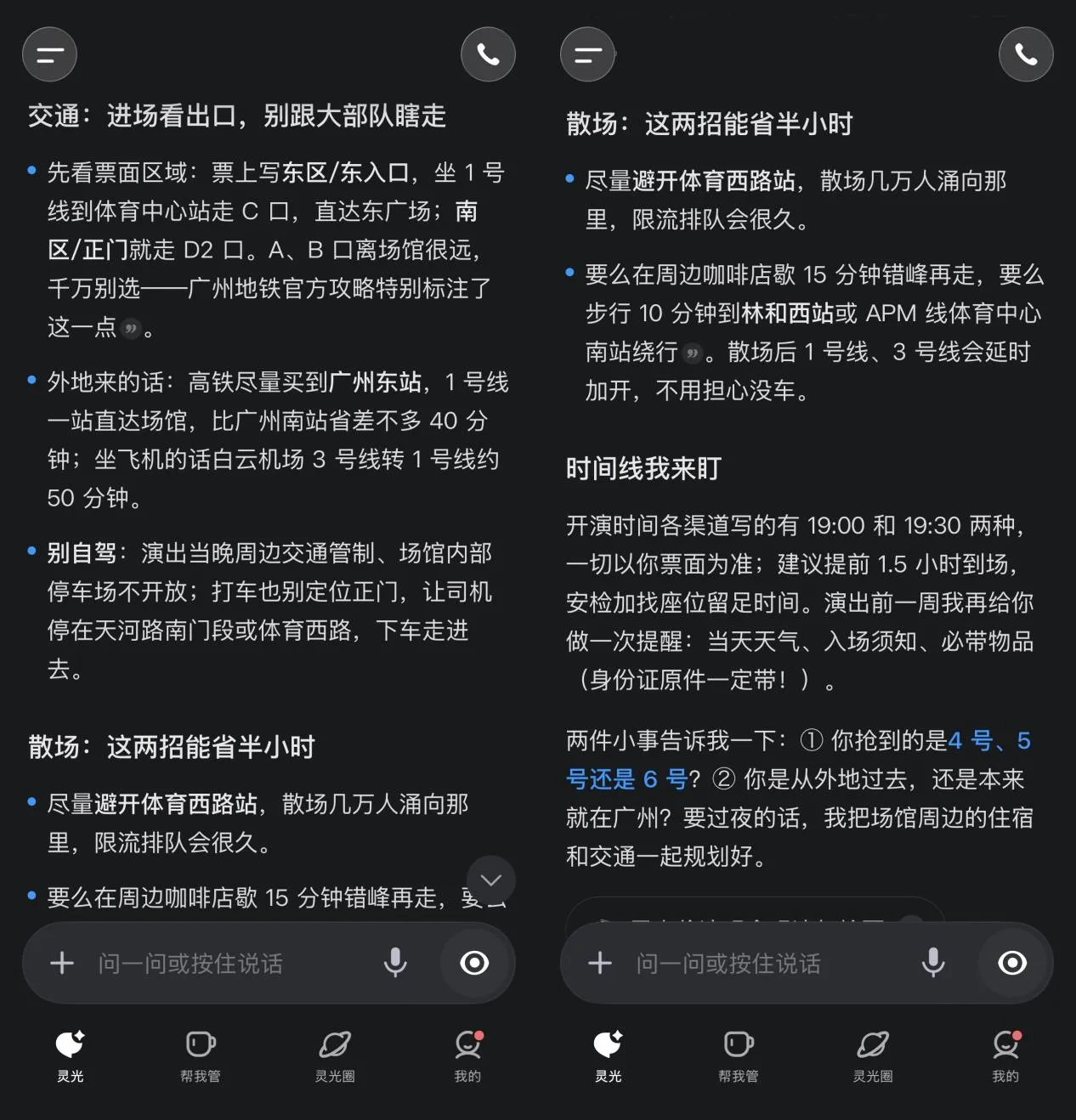
Planning all this ourselves isn’t hard, just tedious: you have to open a map app for subway routes, then open Xiaohongshu for tips, and might miss a step because information is scattered across platforms.
These three scenarios test different requirements for a personal agent: connecting sequential steps, tracking task progress, and alerting users at decision points. Taken together, they show that Lingguang 2.0’s approach to problem-solving is genuinely different from previous AI products.
Global Competition Heats Up: Where Does Lingguang 2.0 Fit In?
Lingguang is far from the only player in personal AI agents. Meta’s exploration of personal AI agents reflects a similar trend: making AI more proactive in helping users manage affairs. The two differ, however, in their underlying ecosystems, accessible services and covered scenarios.
Meta owns social products like Instagram and WhatsApp, with social connections, messages and content as core ecosystem resources. Lingguang, by contrast, is built on the Alipay system and further connects to services like DingTalk, Lark, email and Mijia.
For users in China, spending records, membership services, travel plans and work information are often scattered across different apps. If AI can call on these services with user authorization, it has the chance to string together previously fragmented operations.
That is what makes Lingguang 2.0 noteworthy: it seeks to integrate AI capabilities with existing life service ecosystems, moving personal AI agents beyond chat windows and into concrete scenarios of consumption, travel, work and family life.
Ultimately, global competition in personal AI agents will not be decided by model capabilities alone. Whoever can best combine models, tools, service ecosystems and security mechanisms will stand a better chance of weaving AI into users’ daily lives.
Conclusion
Looking back at the evolution of AI: chatbots solved the problem of instant information access and one-off interactions. Personal AI agents represented by Lingguang 2.0, however, officially usher in a new era of long-span, time-aware intelligent agents.
Rather than measuring AI by how many obscure facts it knows or how many simple one-way commands it completes, a new standard of agent value is emerging: whether AI can truly understand users’ long-term needs, proactively step in at the right moment, and consistently manage the messy trivialities of daily life.
With the all-new upgrade of Lingguang 2.0, the era of AI handling life’s small errands for us is already within reach.