
 雷科技






Foldable Device Development: Zero Times or Countless Times?
After its first foldable smartphone, the iPhone Duo, caused a sensation, Apple's second foldable device is not far away. Recently, digital blogger @Kang revealed that Apple is testing a large foldable tablet similar to a Huawei device.
The Huawei device mentioned by the blogger is likely the MateBook Fold, a foldable laptop. In this light, Apple's device will probably, like the MateBook Fold, combine the advantages of a tablet and a laptop.
According to verification by Lei Technology (ID: Leitech), as early as a year ago, Tianfeng International analyst Ming-Chi Kuo revealed that Apple was developing a foldable tablet with an unfolded size of 18 to 20 inches. Earlier this year, Bloomberg reporter Mark Gurman reported that Apple is still advancing the project, but it may not launch in 2028 and could be delayed until 2029.
However, what Lei Technology is truly concerned about is not the foldable tablet itself, but the fact that the entire digital technology sector is blurring the boundaries between smartphones, tablets, and laptops. This is making digital products, much like "crossover" vehicle models such as coupe SUVs, combine the strengths of different product categories.
Integration of Form and Function Has Become an Industry Trend
In 2019, Samsung and Huawei launched foldable smartphones one after another. The inner screen of the Galaxy Fold reached 7.3 inches when unfolded, while the Mate X boasted an even larger 8-inch display when opened. At the time, the prevailing industry view was that foldable phones function as regular bar phones when closed and transform into small-sized tablets when unfolded—one device serving two purposes.
Later, Huawei and Samsung also launched tri-fold phones. Among them, the Huawei Mate XT has a maximum screen size of 10.2 inches when unfolded, with office, audio, and entertainment experiences on par with large-sized tablets.

(Source: Photo by Lei Technology)
While smartphones are crossing over to challenge tablets, tablets are also fighting back against phones with smaller sizes and gaming optimizations. Some small tablets even support SIM or eSIM cards, allowing users to make and receive calls, much like giant 8–9 inch smartphones.
The same is true in the tablet and laptop sectors. Early on, manufacturers improved the office experience of tablets by providing keyboards and styluses, added touchscreen functionality to laptops, and even adopted detachable screen-and-keyboard designs to enable tablet-like handheld operation.
Magnetic and Bluetooth detachable keyboards for tablets are very common in the industry, supported by products such as Apple's iPad and Huawei's MatePad. Touchscreen and detachable laptops are also widespread. Many laptops from Huawei and Xiaomi feature touchscreens, and Apple's new MacBook Pro, reportedly set to launch on October 28, is rumored to be equipped with a touch-sensitive OLED display.
Laptops such as the Huawei MateBook E series and ROG Zephyrus X series adopt a detachable keyboard design, usable both as large tablets and as regular laptops.
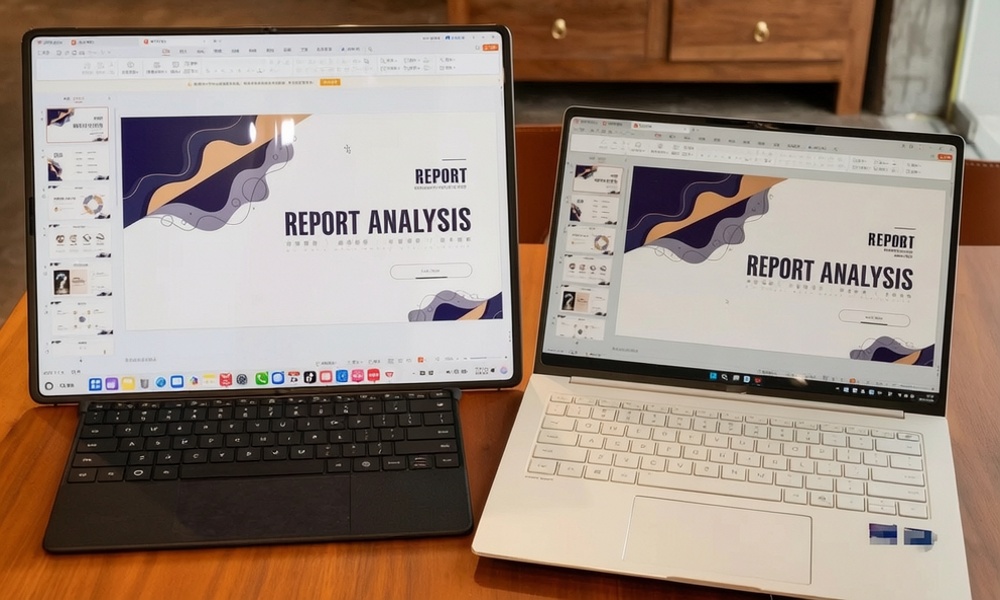
The Huawei MateBook Fold brings foldable screen technology, commonly seen in smartphones, to the laptop industry. The device has an impressive 18-inch display when unfolded and supports the external Huawei Xingyue portable keyboard. If users prefer not to carry a keyboard, they can fold the MateBook Fold at an angle of 90° to 150° to bring up a virtual keyboard.

(Source: Photo by Lei Technology)
The blurring of boundaries between smartphones, tablets, and laptops stems from two factors: changes in user needs and shifts in human-computer interaction logic.
In the early years, user needs were fragmented: phones for communication and socializing, tablets for audio and video entertainment, and computers for work. Today, users demand task continuity—they review materials on their phones while on the go, then switch directly to a large screen for editing once seated, without needing to transfer files back and forth or reopen projects. Staff at Lei Technology often use foldable phones to write articles on buses, subways, and planes during business trips, which is more convenient than pulling out a laptop in cramped spaces.
Features launched by manufacturers, such as continuity, multi-screen collaboration, and cross-device file transfer, are essentially responses to this demand. However, some consumers do not want to purchase or carry multiple devices, hoping a single device can adapt to multiple scenarios.
The development of AI has changed the operational logic of some of our work tasks. For example, when we see a good image and want AI to remove an object from the background or slightly adjust the position of the main subject, we can easily select areas with our fingers on a touchscreen phone.
On a computer, this is manageable with an external mouse, but more cumbersome with a trackpad. To address this issue, some computer manufacturers have even adopted dual-screen designs for laptops, adding an extra touchscreen above the keyboard area for tasks like selecting and drawing.
However, for smartphones, tablets, and laptops to fully replace one another, the most critical hurdle to overcome is the ecosystem.
System Ecosystem: The Biggest Barrier to Blurring Boundaries
Although manufacturers have been trying to blur or even eliminate the boundaries between devices such as smartphones, tablets, and laptops through form design and functional changes, foldable phones still cannot fully replace tablets to this day, and there is an even wider gap between tablets and laptops.
Numerous factors, including system, efficiency, energy consumption, heat dissipation, and usage habits, are preventing different devices from bridging the gap. Among these factors, the system ecosystem is by far the most important.
As a MateBook E user, I can clearly feel the awkwardness of the Windows system during touch operation. Its UI controls are designed for mouse cursors, not fingers. Many operations still follow the logic of single-click to select and double-click to open, which is completely different from tablets and phones. Third-party app compatibility is even more of a mess.

(Source: Photo by Lei Technology)
When using Android foldable phones, Lei Technology also found that many apps have not been adjusted for the inner and outer screen aspect ratios of foldable devices, resulting in forced stretching when unfolded. Even Apple, known for its system adaptation and optimization, faces similar issues. Lei Technology tested 10 car apps on the iPhone Duo, and only Tesla had a dedicated adaptation—and even that had detail problems, such as abnormal image display within the app.
Fortunately, compared to Android and Windows-based devices, Apple and Huawei have significant advantages in blurring device boundaries.
After replacing Intel chips with its self-developed M-series chips, Apple has unified the chips for its smartphones, tablets, and laptops under the ARM architecture. Moreover, Apple's chips for phones, tablets, and laptops can theoretically be used interchangeably—for example, the iPad Air uses the M4 chip, and the MacBook Neo is equipped with the A18 Pro chip—making software adaptation and migration more convenient.
Currently, in the Mac App Store, we can already see many "great iPad games for Macs with Apple chips".
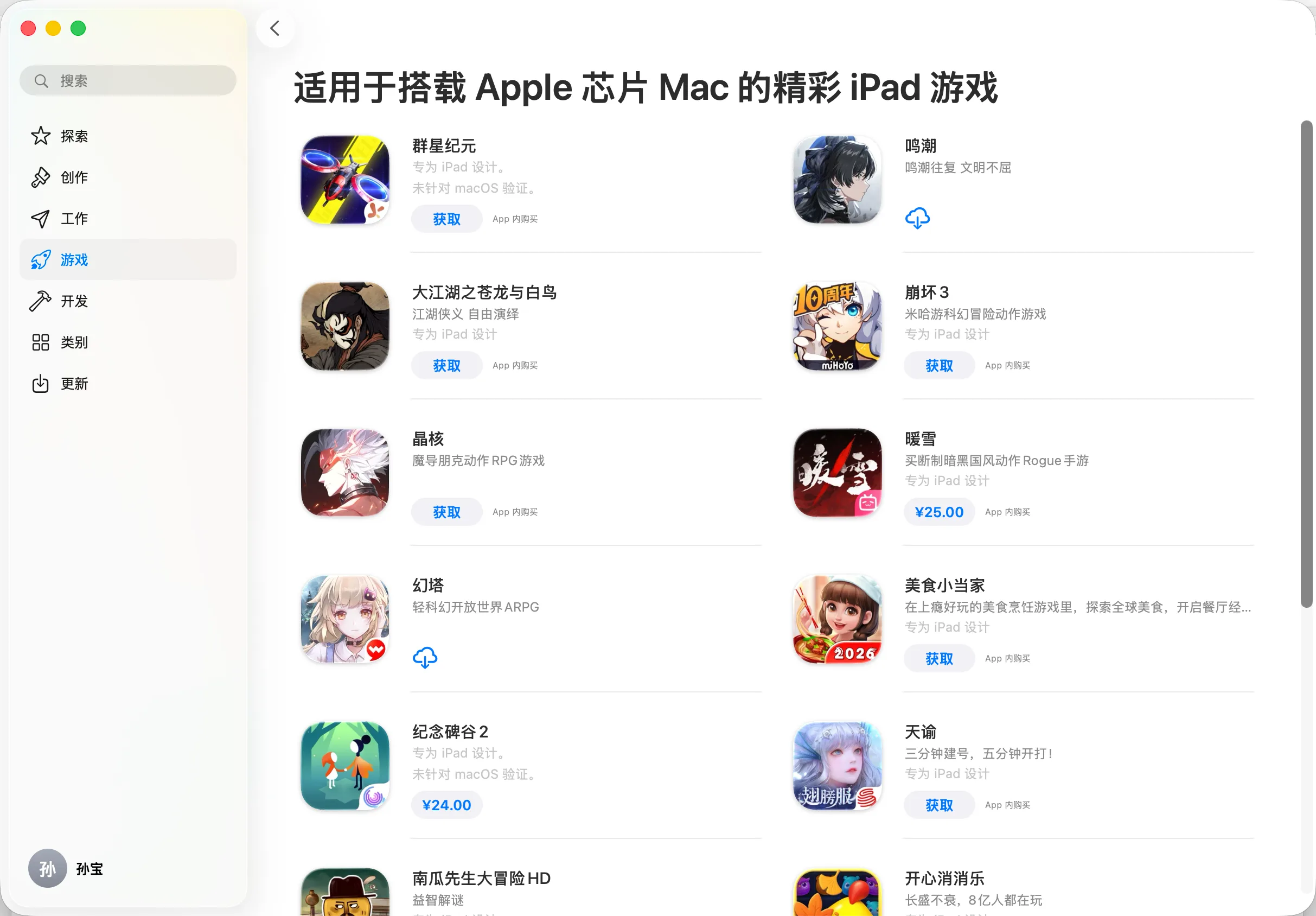
(Source: Screenshot from the Mac App Store)
Huawei has gone a step further with its HarmonyOS system, which supports "develop once, deploy across multiple devices". Developers only need to write one set of ArkTS/ArkUI code and package it into a single HarmonyOS HAP package, which can be installed and run on HarmonyOS devices including phones, tablets, foldables, HarmonyOS PCs, smart screens, in-car systems, and smartwatches. The system automatically adjusts UI layout, interaction modes, and available functions based on screen size, input method, and hardware capabilities.
Of course, this does not mean that HarmonyOS apps can run perfectly across different device categories directly. Developers still need to plan information hierarchies for different sizes, define layout switching rules, and optimize interaction logic and display characteristics.The significance of shared core code is that it can significantly reduce the time and economic costs required for cross-device software adaptation.
The biggest problem with Android and Windows devices is the massive existing stock of APK and EXE software, and many developers lack the incentive to adapt their products for touch, foldable, and other features and designs.
Apple has unparalleled industry influence. Although the iPhone Duo currently has imperfect adaptation and MacBooks have not previously experimented with touchscreen designs, it is believed that given time, developers will complete the necessary adaptations.
Huawei's HarmonyOS operating system and ecosystem were built almost from scratch, giving it a latecomer advantage. In terms of system architecture, it better aligns with the interaction logic of the AI era: intent-first, cross-device collaboration, and service atomization, and it is still being continuously optimized.The shortcoming of HarmonyOS is that its third-party app ecosystem is still growing. The efficiency dividends of "develop once, deploy across multiple devices" will only be realized once the number of apps crosses a critical threshold.
Device Boundaries Will Narrow, But Product Categories Will Not Disappear
While launching one "crossover" device after another, manufacturers face a new question: if consumers buy one type of device, will they no longer need to buy others? And will selling products in separate categories generate more revenue?
At this stage, companies do not need to deeply consider this issue. Although the boundaries between devices are narrowing, significant differences remain. These boundary-blurring products can only provide experiences close to other devices in limited scenarios for the time being. In the short term, no single category among smartphones, tablets, and laptops will replace another.
Take foldable phones as an example: their large screens offer an audio-visual experience close to that of small tablets, but their small batteries and limited heat dissipation mean their gaming experience cannot match that of small tablets.
The Huawei MateBook Fold allows input via a virtual keyboard when folded at a certain angle, similar to a laptop. However, a virtual keyboard with no key travel can never match the typing feel of a real laptop keyboard. Not to mention industrial scenarios, which have strict requirements for device operating systems and hardware configurations, making them hard to replace with "crossover" devices.
Therefore, Lei Technology believes that as system ecosystems continue to improve and hardware such as foldable screens, hinges, UTG ultra-thin glass, and flexible OLEDs continues to advance, crossover devices including foldable phones, foldable laptops, foldable tablets, and touchscreen/dual-screen laptops will provide better experiences in specific scenarios—but will most likely never completely replace one another.