 雷科技






Under the “AI + Automotive” wave, vehicles are increasingly exhibiting attributes of consumer electronics and AI hardware. As such, CES—the International Consumer Electronics Show, long regarded as the barometer of consumer electronics—has evolved in recent years into a major stage for automakers, even jokingly dubbed by tech media as “America’s second-largest auto show.” At CES 2026, numerous automakers participated, with topics including on-vehicle large AI models, autonomous driving, and automotive intelligent agents dominating discussions. Jensen Huang, founder and CEO of NVIDIA, unveiled Alpamayo—an open-source physics-based AI inference model designed to tackle autonomous driving’s “long-tail problems.”
CES 2027 is set to kick off in Las Vegas on January 6, 2027, with mobility officially announced by the organizers as a key theme this year.
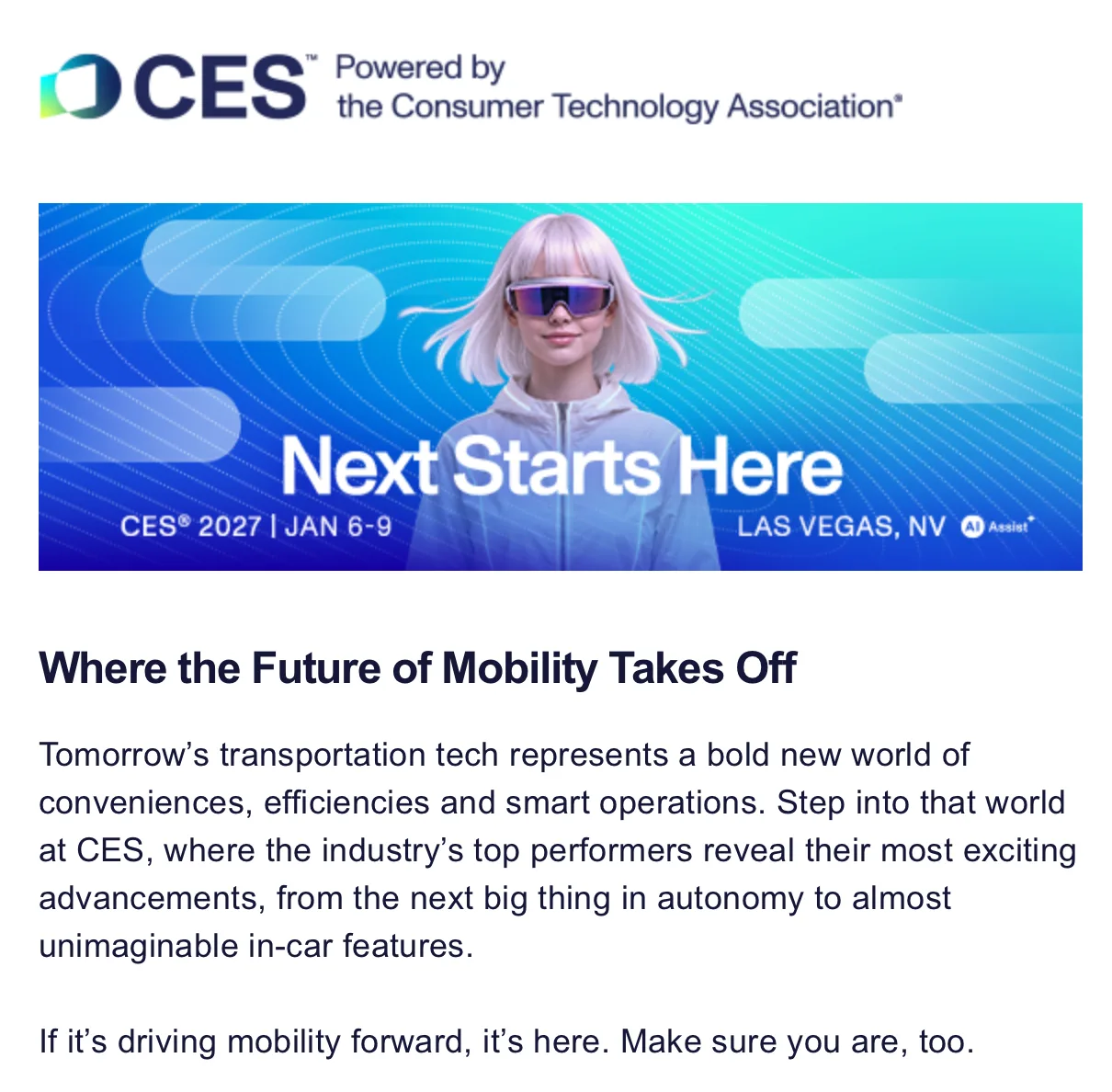 (Source: Official CES email sent to LeiTech)
In early September, global automotive giant Stellantis confirmed it will deliver a keynote speech on the opening day of CES 2027. Stellantis was formed on January 16, 2021, through an equal merger between PSA Group (Peugeot Citroën Automobiles) and Fiat Chrysler Automobiles (FCA). Its portfolio includes Peugeot,
The latest official CES email reveals that the first batch of mobility-focused companies confirmed for CES 2027 has been announced—with Chinese automakers Geely and XPeng prominently featured.
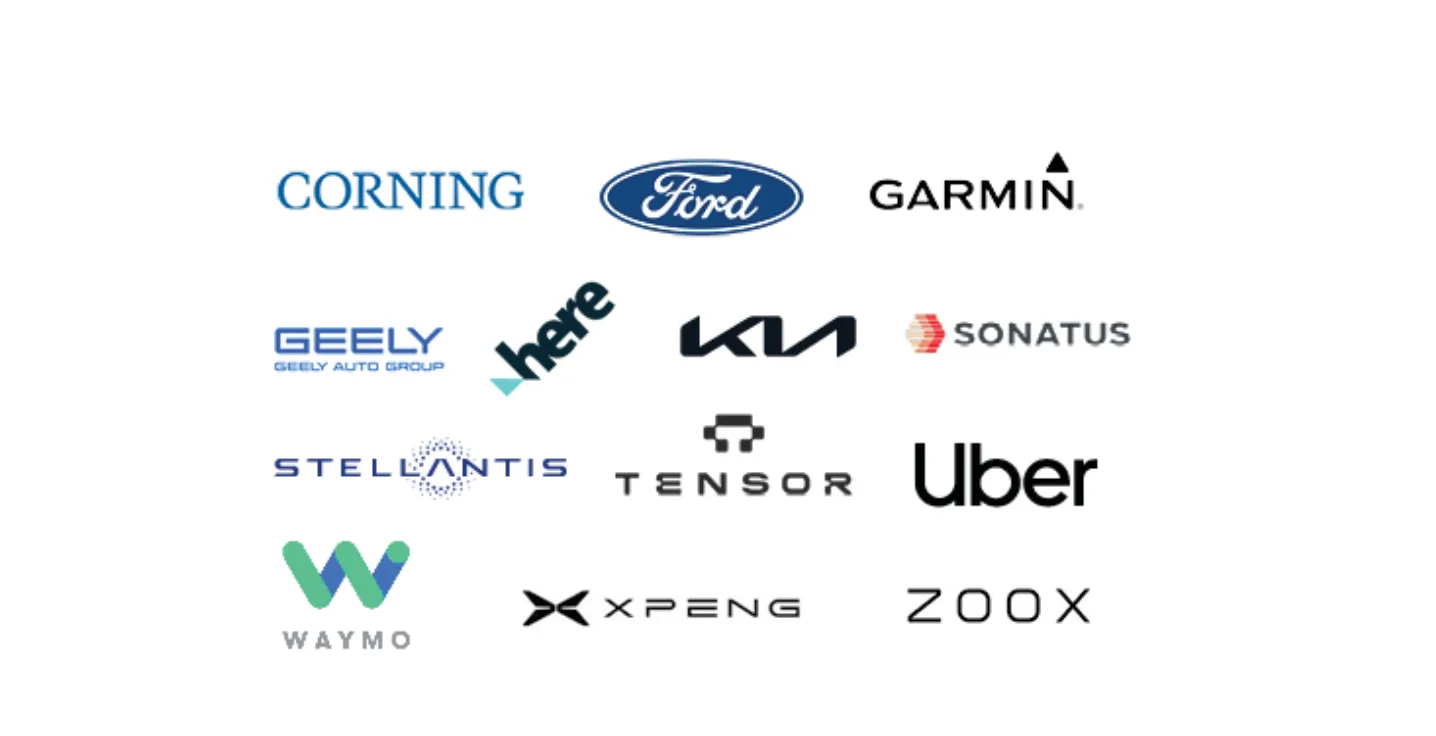
(Photograph source: CES)
Almost simultaneously, Geely Holding Group announced that its subsidiary Geely Auto has officially entered the Canadian market, actively building local retail and service networks, and plans to launch its first vehicle models there in 2027. Against this backdrop, CES holds heightened strategic importance for Geely Auto: while IFA/IAA exert influence primarily across Europe and Africa, CES’s core impact lies in the North American market—making participation crucial for Geely’s expansion into Canada and the broader North American region. It is foreseeable that the listed mobility companies represent only the tip of the iceberg, with more automakers and mobility players expected to join CES 2027 in the coming months.
Accelerating Global Expansion: Chinese Automakers Emerge as New CES Protagonists
Although high U.S. tariffs pose entry barriers for domestically produced new-energy vehicles (NEVs), the number of Chinese brands participating in CES continues to hit record highs—driven by China’s overcapacity in automotive manufacturing and the industry-wide push toward overseas markets.
Since entering 2026, the domestic NEV market has faced mounting pressure, prompting homegrown brands to intensify their focus on overseas expansion. According to data released by the China Association of Automobile Manufacturers, China exported 5.096 million vehicles in the first half of this year—a 65.3% year-on-year increase—while NEV exports reached 2.355 million units, surging 120% year-on-year.
Brands including BYD, Chery, Great Wall Motor (GWM), Geely, XPeng, Li Auto, and NIO all regard international expansion as a top strategic priority—and thus require prominent global platforms to “showcase their muscle.” As a globally renowned exhibition, CES offers unparalleled visibility: even for those not yet entering the North American market, participation strengthens global brand influence. Consequently, Chinese automakers are placing growing emphasis on this platform.
(Source: Generated by Doubao AI)
Notably, XPeng—absent from CES 2026—has now confirmed its participation in CES 2027. At CES 2024 and 2025, XPeng showcased mainly its Huitian flying car concept rather than passenger vehicles. In 2027, however, XPeng is highly likely to bring its G-series, P-series, and MONA-series production vehicles onto the CES stage.
As a benchmark player in China’s indigenous intelligent driving technology ecosystem—often nicknamed “China’s Tesla”—XPeng is aggressively advancing RoboTaxi services and developing proprietary chips. LeiTech believes that amid the concentration of mobility platforms—including Waymo, Zoox, and Uber—at CES 2027, XPeng will spotlight its intelligent driving technology, proprietary chips, RoboTaxi operations, the GX platform targeting L4 autonomy, and the right-hand-drive G9L variant tailored for 64 markets including Australia and Southeast Asia.
Two other Chinese EV startups—NIO and Leapmotor—may also appear at CES 2027. Both participated in CES 2026 but did not secure independent booths: NIO displayed its ET9 sedan at Dolby Live in Park MGM, while Leapmotor jointly unveiled a cross-domain integrated central controller powered by dual Qualcomm Snapdragon 8797 chips with Qualcomm.
Geely and Great Wall Motor both exhibited at CES 2026 and maintained independent booths.
On the opening day of CES 2026, Great Wall Motor (GWM) held a high-profile press conference themed “GO With More Life,” showcasing core technologies including ASL, the Hi4-Z architecture, V8 engines, hydrogen fuel-cell engines, and semi-solid-state batteries. The LeiTech CES 2026 reporting team was honored to interview Dr. Huiqiao Wu, CTO of Great Wall Motor.
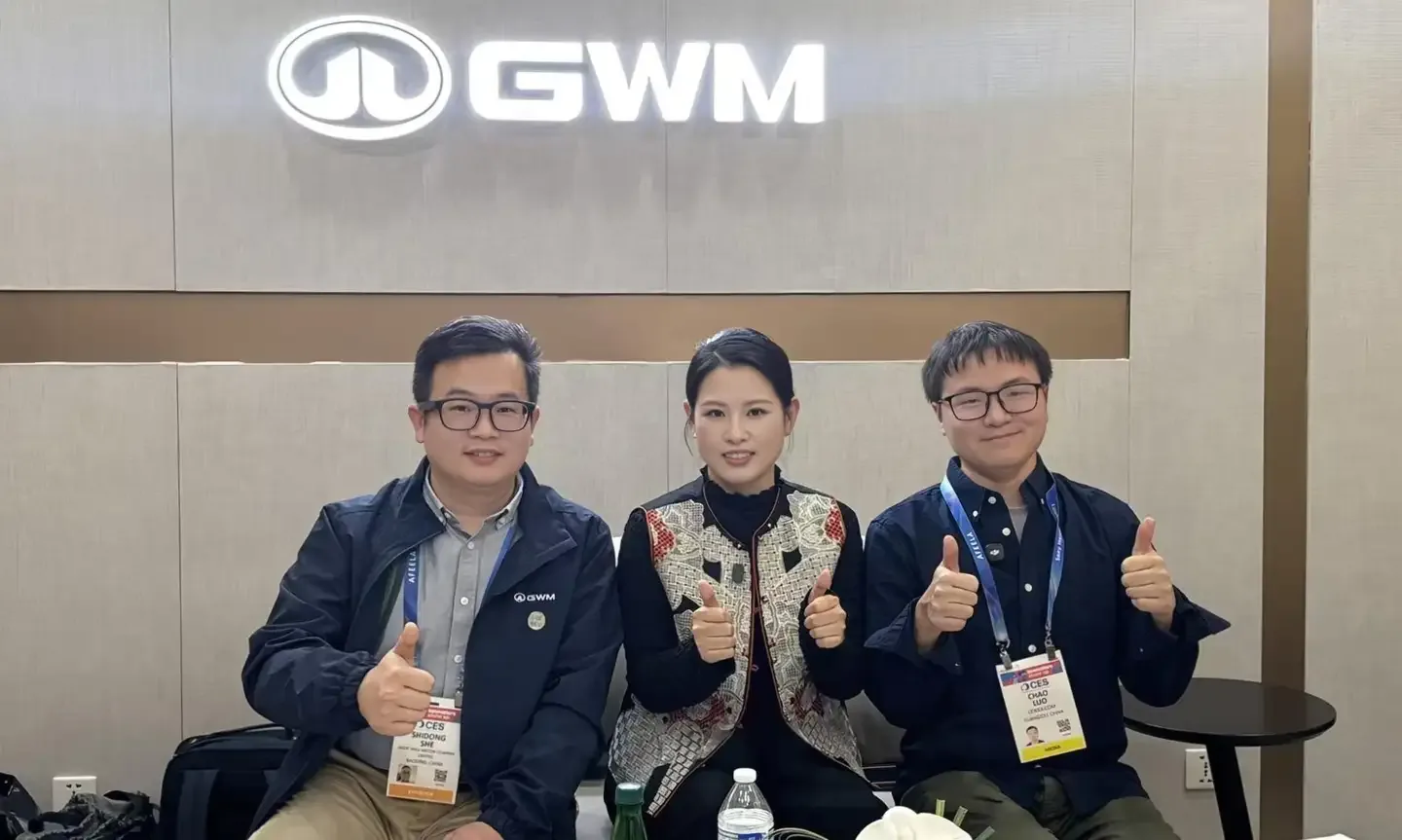
The LeiTech CES 2026 reporting team was also invited to attend Geely’s pre-CES 2026 event. There, Geely exhibited models from its Zeekr and Galaxy brands and debuted its WAM (World Action Model), unveiled the English name of its advanced driver-assistance system “Qianli Haohan”—G-ASD—and announced the integration of Vision-Language-Action (VLA) and World Model (WM) technologies. Geely also formally launched its RoboTaxi initiative, elevating its full-stack AI technical architecture to Version 2.0.

(Photograph source: DiancheTong filming at CES 2026)
The announcement of “Qianli Haohan’s” English name at CES 2026 signaled Geely’s earlier planning for North American market entry. From its participation in CES 2026, through subsequent strategic moves this year, to securing its CES 2027 slot ahead of schedule, Geely’s North American rollout has been meticulously orchestrated. With Canada serving as its North American entry point, Geely’s exhibits and technological innovations at CES 2027 are certain to surpass those of CES 2026 in both scope and impact.
DiancheTong (ID: dianchetong233) predicts that Geely and Great Wall Motor—which showcased multiple models at CES 2026—are poised to expand their booth footprints at CES 2027, and more Chinese automakers, including BYD and Xiaomi, are likely to secure independent booths.
Of particular interest is Xiaomi, which is accelerating its global expansion and recently displayed multiple production and concept vehicles—as well as its distinctive “Human-Vehicle-Home” ecosystem—at IFA 2026. At CES 2027, Xiaomi may introduce its “Human-Vehicle-Home” paradigm and showcase flagship new models such as the Pengcheng series.
In the NEV era, Chinese automakers have achieved overtaking maneuvers relative to overseas competitors. At virtually every international auto exhibition they attend, Chinese enterprises capture global attention through breakthrough technologies and innovative products. At this pivotal juncture before Level-3 (L3) autonomous driving achieves commercial deployment, DiancheTong forecasts that numerous Chinese automakers will unveil new products built upon L3 autonomous driving architectures at CES 2027.
What Makes CES Irresistible? Always the Next Big Technology
CES remains the de facto “barometer” of the consumer electronics industry because many companies choose it to debut groundbreaking technologies and products. Of course, the automotive industry hosts numerous specialized exhibitions—including China’s two mega-events, Auto China Beijing and Auto Shanghai—where truly novel technologies rarely premiere. Nevertheless, CES consistently showcases a rich array of cutting-edge automotive technologies and products.
For instance, at CES 2026, Great Wall Motor exhibited its Spatial Language Intelligent Agent large model, Coffee EEA 4.0, ASL 2.0, Hi4-Z, semi-solid-state batteries, hydrogen fuel-cell engines, and V8 engines across its entire lineup.
Considering current trends in the NEV industry, the mainstream trajectory for intelligent driving centers on end-to-end VLA plus World Models—evolving beyond basic “perception-decision-execution” frameworks to predict surrounding objects’ motion trajectories and proactively respond, thereby significantly enhancing driving safety. For example, XPeng’s X-Foresight predictive world model can simulate events up to six seconds into the future.
Beyond world models, another dominant trend in intelligent driving is data simulation. Real-world driving data forms the foundation for training intelligent driving systems; data simulation, meanwhile, generates abundant long-tail and challenging scenarios within virtual environments—enabling targeted training and improving system performance under high-difficulty conditions. At CES 2027, enhancements to world models and data simulation capabilities will remain focal points.
(Source: Generated by Doubao AI)
Regarding AI advancements, trends remain consistent with previous years: BYD’s “DIDI-Xia” AI assistant and Li Auto’s self-developed Mind GPT both reflect the ongoing evolution of in-vehicle AI toward “embodied robotics”—capable of executing increasingly complex user commands, including high-level intelligent driving, ticket booking, and e-commerce transactions.
Stellantis’ upcoming keynote will likewise emphasize integrating advanced technologies across vehicles, software, and digital ecosystems to enhance user experience through human-centered design and intelligence.
Within the two pillars of NEV development—electrification and intelligence—the core of electrification lies in the “three-electric” (3E) system, with battery technology representing the most critical component. While phrases like “solid-state batteries are about to enter mass production” may sound repetitive, solid-state batteries are indeed drawing closer to reality.
This year, semi-solid-state batteries developed by Chery, Dongfeng, CATL, and SVOLT have already entered mass production and vehicle integration; fully solid-state batteries remain under testing, with small-batch pilot production anticipated in 2027. Coinciding with the start of the new year, battery manufacturers are highly likely to unveil solid-state battery technologies at CES 2027.
It bears noting that seven Chinese government ministries—including the Ministry of Industry and Information Technology—recently jointly issued the “15th Five-Year Plan for New Battery Industry Development,” targeting preliminary large-scale application of fully solid-state batteries by 2030. On October 9, A-share stocks in the solid-state battery sector surged collectively, with multiple stocks—including Keheng Co., Ltd. and Fengyuan Co., Ltd.—hitting daily trading limits—underscoring the sector’s robust momentum.
In the NEV era, while market entry barriers may appear lower, without deep-rooted technological expertise, products struggle to stand out competitively. Consumers choose BYD vehicles largely due to BYD’s leadership in 3E technologies and product quality. Even Leapmotor—renowned for value-for-money—launched its self-developed world model this year, vying for a top-tier position in intelligent driving technology. We anticipate numerous automakers will unveil their latest R&D achievements at CES 2027.
RoboTaxi: Another Mobility Highlight at CES
Among the list of mobility companies officially confirmed by CES, DiancheTong noted four names: Uber, Waymo, Zoox, and Tensor. The first three are widely recognized: Uber dominates the global ride-hailing market, while Waymo (under Google) and Zoox (under Amazon) lead the RoboTaxi space.
At CES 2026, Uber, Waymo, and Zoox all exhibited RoboTaxi vehicles, with Zoox unveiling a RoboTaxi featuring no steering wheel or pedals. On July 30, Zoox secured the world’s first commercial operating license for a steering-wheel-free, driver-compartment-free RoboTaxi—gaining a competitive edge over Tesla.
Tensor is a startup specializing in autonomous vehicles. Last year, it partnered with U.S.-based Lyft Inc. to deploy a RoboTaxi fleet comprising hundreds of autonomous vehicles across North America by 2027.
Unquestionably, RoboTaxi represents another highlight at CES 2027. Moreover, the steering-wheel-free and pedal-free designs championed by Zoox and Tesla are poised to become the industry’s dominant trend. Removing these traditional safety features signals profound confidence in intelligent driving capabilities.
Given RoboTaxi’s strong geographical constraints, leading Chinese players—including Baidu Apollo, WeRide, Pony.ai, and DiDi RoboTaxi—are unlikely to exhibit independently at CES 2027. However, they may jointly showcase select technologies and vehicles with Tier-1 suppliers such as Hesai, Black Sesame Technologies, Zoyote, Horizon Robotics, and Momenta.
With nearly three months remaining until CES 2027 opens, concrete industry disclosures remain limited—but it’s safe to predict that the mobility segment’s excitement level will comprehensively surpass that of CES 2026.
As automakers accelerate overseas expansion, international exhibitions gain greater strategic weight. With Geely and XPeng having secured their spots early, and BYD, Xiaomi, and Great Wall Motor among others likely to join, more automakers are expected to unlock independent booths—propelling Chinese brands to center stage in the mobility segment.
(Source: Generated by GPT AI)
Ongoing iterations in intelligent driving technologies—including VLA world models and data simulation—combined with in-vehicle AI’s progression toward embodied robotics and the imminent industrial breakthrough in solid-state battery technology, will collectively demonstrate the latest achievements in NEV intelligence and electrification.
While many leading Chinese RoboTaxi players may be absent, the new directions pioneered by Tesla, Zoox, and Waymo remain highly noteworthy.
Given the early timing and scarcity of confirmed information, DiancheTong must rely on historical CES mobility exhibitor patterns and this year’s NEV industry developments for analysis. We expect major automakers to begin pre-launching CES 2027 announcements in the coming weeks—revealing further critical details—and DiancheTong will continue tracking developments closely.
Having just concluded coverage of IFA 2026, the LeiTech/DiancheTong team has already entered full preparation mode for CES 2027. We will dispatch our largest-ever reporting contingent to Las Vegas, delivering comprehensive, professional, and timely on-the-ground coverage—from editorial planning to content creation—ensuring you receive the most authoritative CES 2027 insights.
In early January, CES 2027—the global benchmark for consumer electronics and technology industries—will open in Las Vegas, USA.
As China’s longest-established, most in-depth, and most professional new media outlet covering technology exhibitions, the LeiTech CES 2027 reporting team is conducting intensive preparatory work. LeiTech will deploy its largest-ever CES reporting team, led by LeiTech’s founder and Editor-in-Chief Luo Chao, to deliver frontline, professional, and multidimensional coverage of CES 2027. Stay tuned!