
 雷科技





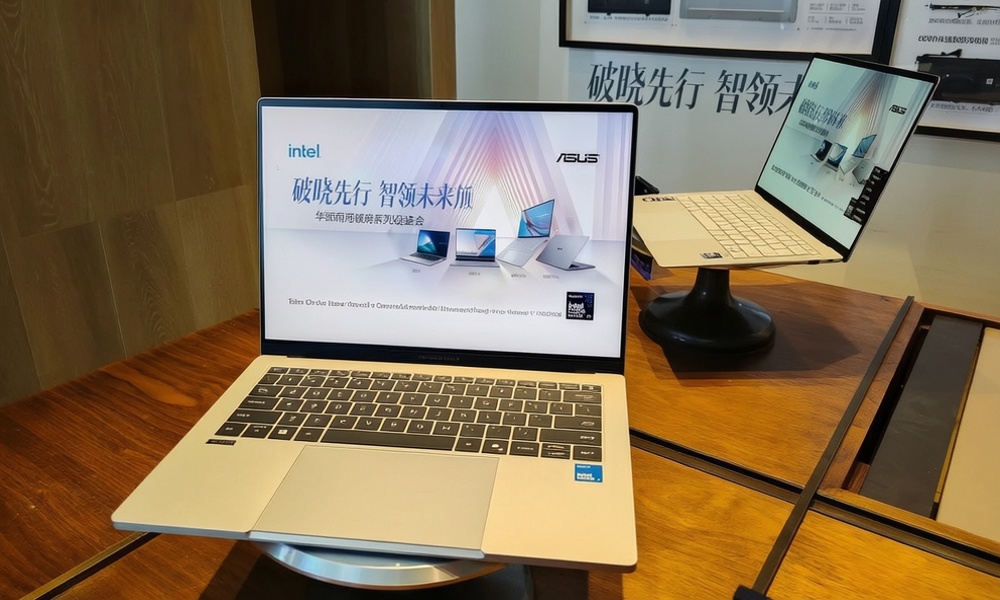

On September 21, ASUS held an appreciation event for its commercial Dawn series in Beijing, themed “Forge Ahead at Dawn, Lead the Future with Intelligence”.
A host of new products were unveiled at the event, including the brand-new lightweight business laptop Dawn Air. The Dawn series made a collective appearance, covering business laptops, desktops, all-in-one PCs and mini hosts. Two experience zones were set up on site: the SMB small-and-medium enterprise office area and the OPC One-Person AI Comic Studio.
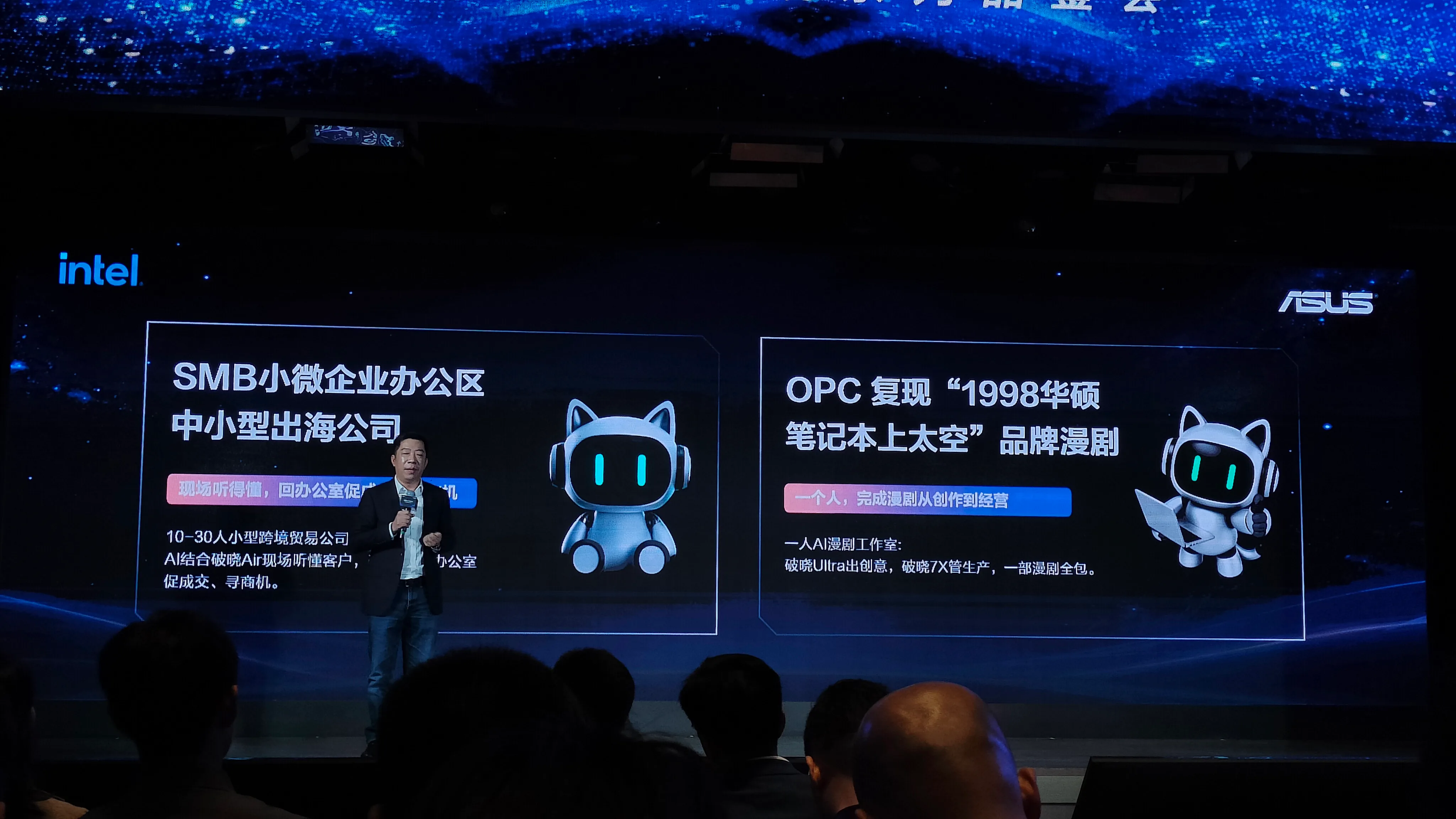
(Photography credit: LeiTech)
Besides ASUS, key partners Intel and Tencent also attended the appreciation event, contributing expertise at the hardware and software layers respectively. Leitech (ID: leitech) observed on-site that AI in office scenarios is no longer limited to conversational interactions. It is rapidly evolving toward Agent capability, able to interpret user intent, break down tasks, call up tools and organize outputs.
Partnering with Intel, ASUS builds AI capabilities for PCs at the hardware foundation
The Dawn Air lightweight laptop stood out as one of the stars of the event. It features a CNC-machined integrated aerospace aluminum chassis, weighing approximately 1.28 kg and measuring just 10.4 mm thin. It comes with a 14-inch 2.8K anti-glare OLED display covering 100% DCI-P3 color gamut. Powered by the 3rd Gen Intel Core Ultra 7 350 processor built on the 18A process, the chip has 6 cores and 6 threads with a maximum turbo frequency of 4.8 GHz, and integrates an NPU inside the processor.
From exterior design and hardware performance to the display panel, the ASUS Dawn Air is a generously specced lightweight notebook.
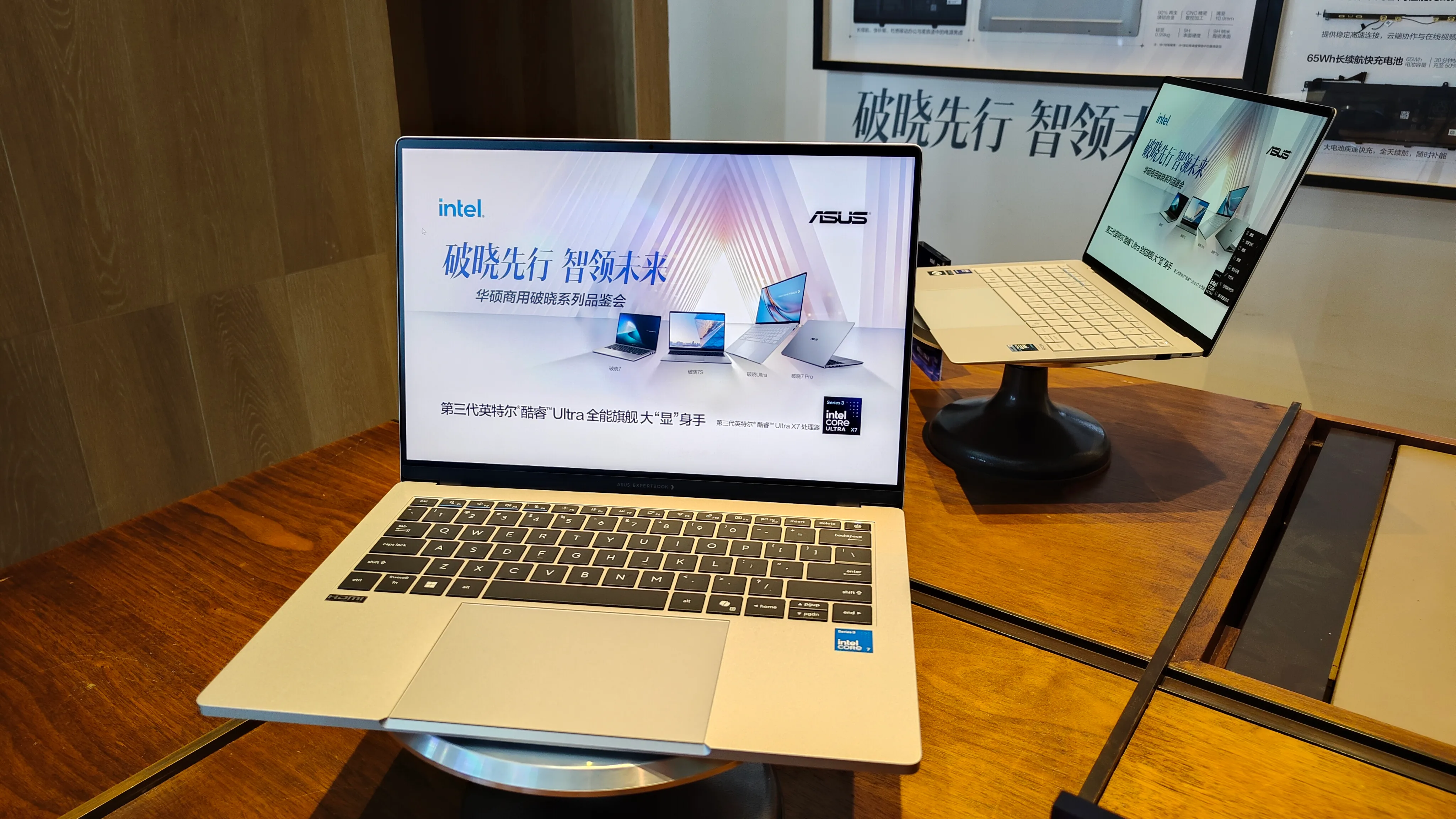
(Photography credit: LeiTech)
For business scenarios, ASUS Dawn Air features performance tuning optimized specifically for business meetings. Noise is kept below 32 dB in standard mode. This detail shows ASUS fully understands the needs of its target users. These users do not chase extreme performance or benchmark scores; instead, they care more about whether the laptop can run steadily during long video conferences in meeting rooms without distracting noise.
As mentioned earlier, the full Dawn family of PCs in diverse form factors made their debut at the event.
Positioned as an all-round flagship, the Dawn Ultra is equipped with the 3rd Gen Intel Core Ultra X7 358H processor, packing 16 cores and 16 threads with an NPU computing power of 50 TOPS. It sports a 14-inch 2.8K stacked dual-layer OLED touchscreen. The Dawn 7X desktop comes with the Core 7 240H processor, 16 GB DDR5 5600 MHz memory as standard and up to 1 TB PCIe 4.0 SSD. The chassis is available in two sizes: 8.6 L and 15.9 L. The Dawn all-in-one PC boasts a 27-inch 100 Hz narrow-bezel anti-glare display, while the VM61 mini PC weighs around 750 g.
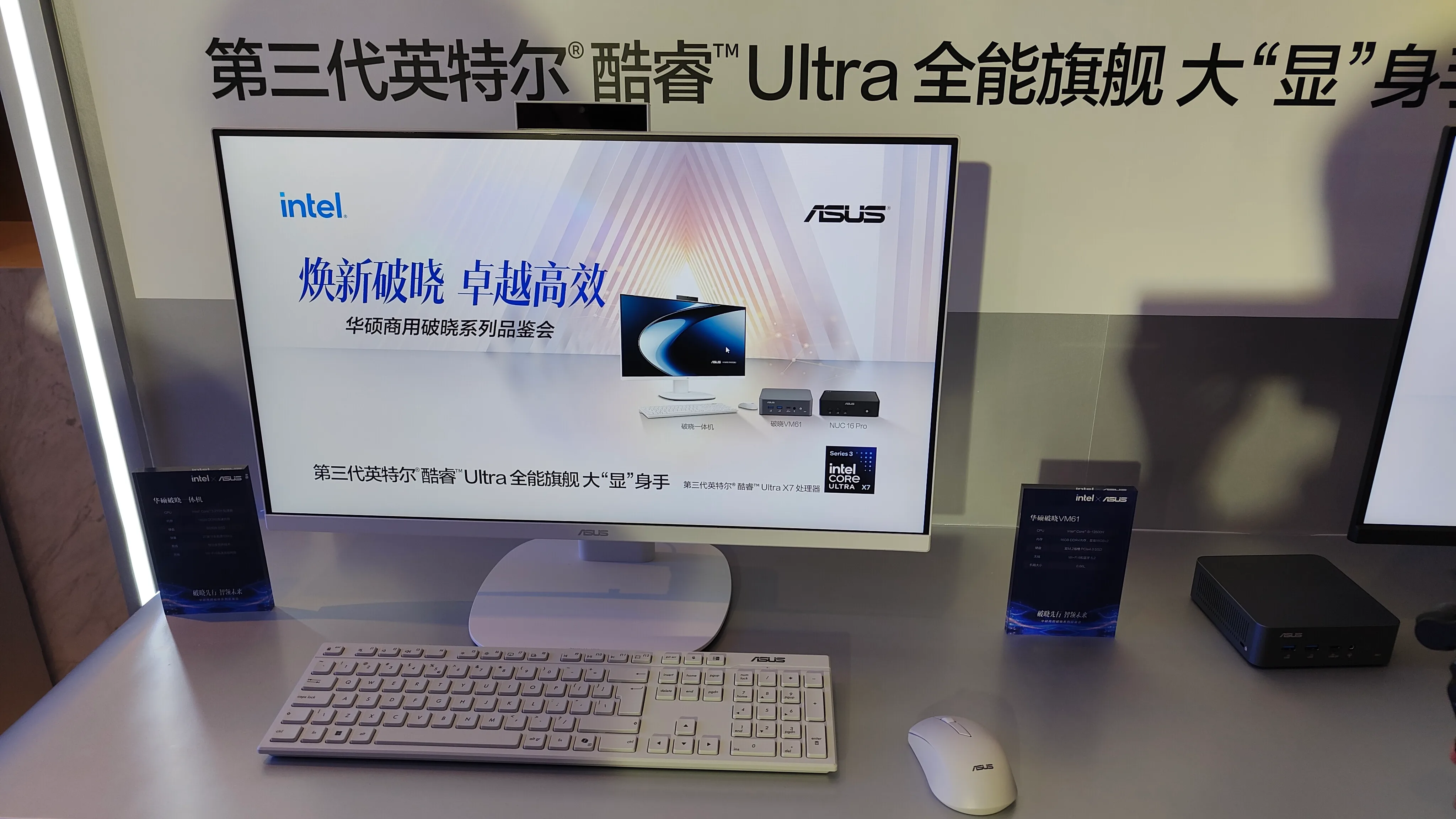
(Photography credit: LeiTech)
Looking at these specifications, we can see that Intel’s chips play a vital role in the Dawn series PCs. They deliver not only CPU and integrated graphics performance but also AI computing power. Beyond that, Intel’s support for ASUS tailored to real-world scenarios extends to local Skills for AI Agents.
Intel has currently deployed 14 local Skills on WorkBuddy, covering speech recognition, optical character recognition (OCR), speech synthesis and other capabilities. According to Intel, leveraging the locally optimized 35B-A3B model, the company has completed local adaptation and optimization for 26 frequently used WorkBuddy expert agents. The terminal can automatically identify the device’s processor and platform configuration via CPU ID Check, recommend compatible local expert models, and support one-click download and deployment.
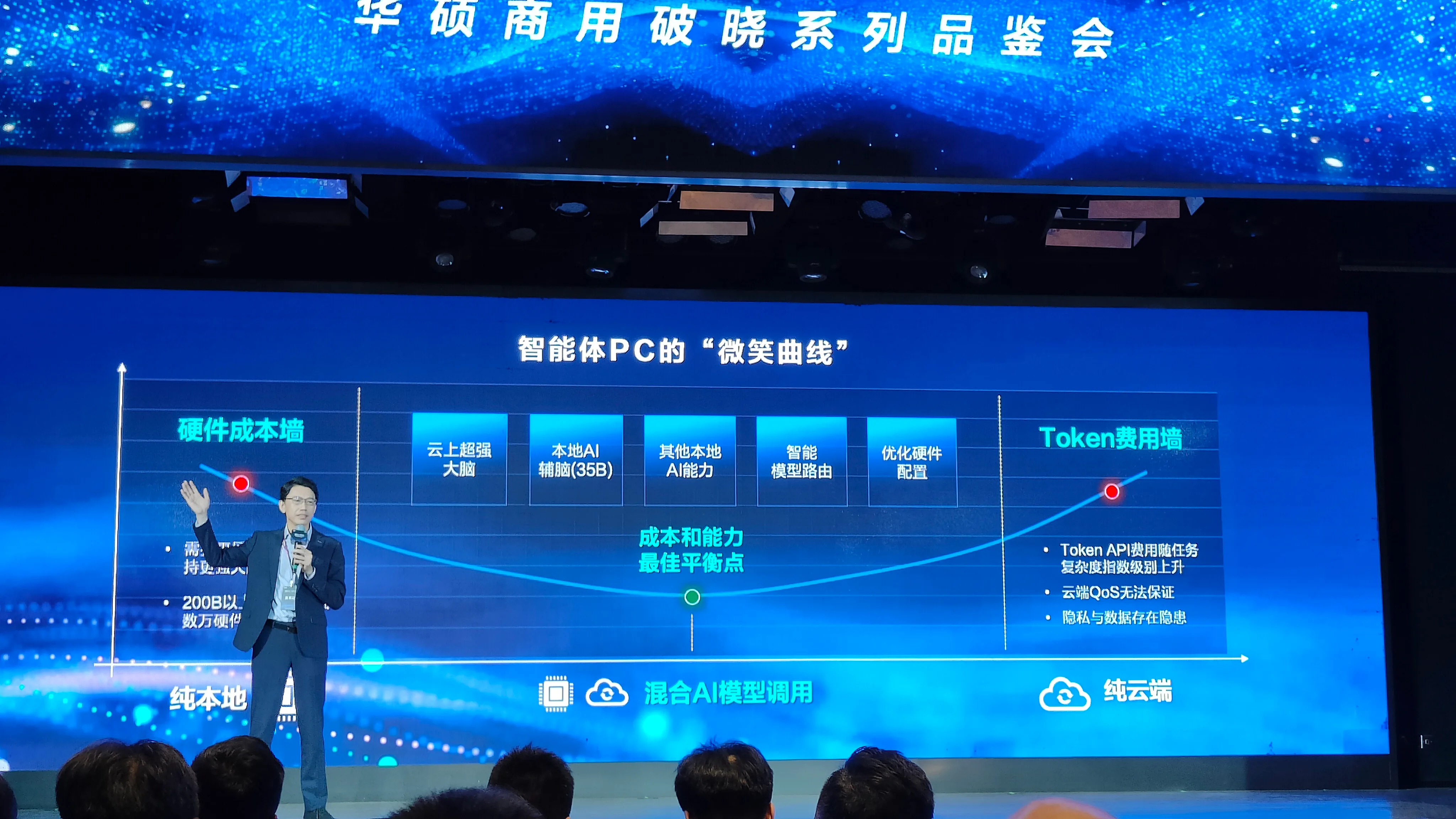
This brings the concept of edge-cloud collaboration for AI PCs to real-world implementation. High-frequency tasks suitable for local processing are handled by on-device computing power, while tasks requiring stronger model capabilities or online information tap into cloud services. A local intelligent router determines how to allocate workloads between the two. For small and medium-sized enterprises with dozens of employees, routine work such as expense document recognition and meeting audio transcription no longer needs to run on cloud models every single time.
Intel and ASUS have also proposed a “smile curve” cost model built on the edge-cloud hybrid architecture. Though the name may sound abstract, it essentially means tasks that can run locally should not be sent to the cloud, and tasks requiring cloud resources should not be forced to execute locally. Each side handles its appropriate workload to achieve long-term efficiency and optimal costs. This also explains why Intel is shifting its focus away from mere chip specifications toward the quantity and compatibility of Skills.
(Photography credit: LeiTech)
Tencent WorkBuddy Joins In: AI Agents Take Over Workflows
As a partner, Tencent’s core support for ASUS PCs is closely tied to WorkBuddy. ASUS is the first PC manufacturer to launch an exclusive version of WorkBuddy. The “Xiaoshuo Knowledge & WorkBuddy Exclusive Edition” embeds AI capabilities directly into ASUS Dawn PCs.
Liu Yong, Vice President of Tencent, shared his insights on site:
AI has moved past the early stage of question-and-answer interaction and officially entered the era of AI Agents that can understand intent, break down tasks, invoke tools and deliver finished outputs.
Within office scenarios, the role of the PC is undergoing a transformation. Previously merely a device for document processing and content output, it is now evolving into a gateway capable of handling complex tasks.
ASUS, Intel and Tencent each have distinct roles in this ecosystem. Intel leverages on-device chip computing power and local Skills to handle certain recognition and parsing tasks. WorkBuddy further processes the organized information with cloud AI models and other cloud capabilities. ASUS Dawn PCs provide the corresponding physical hardware and operating environment. Naturally, users remain part of the workflow: they need to monitor the Agents’ work progress, edit content, and take ownership of the final deliverables.
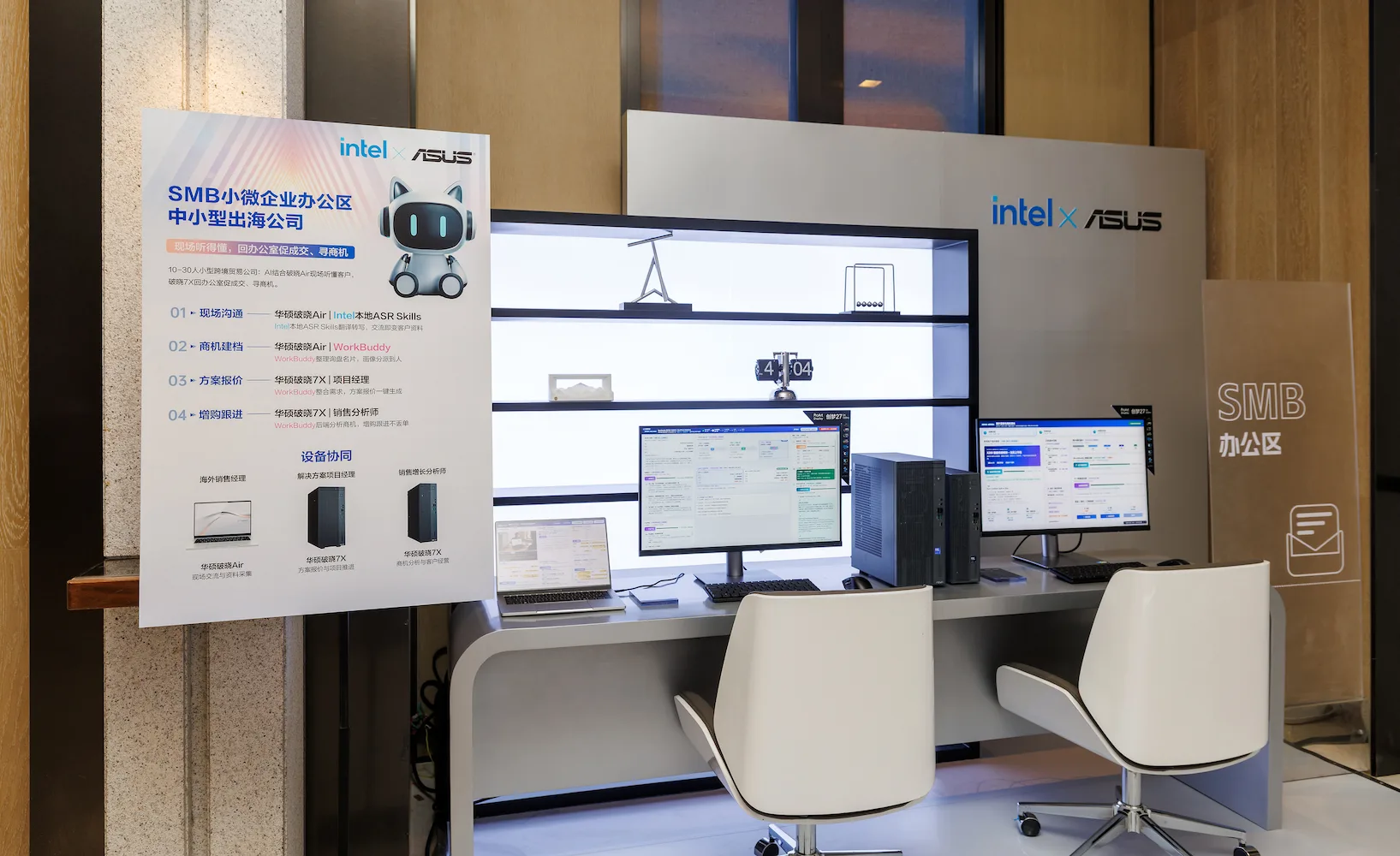
At the on-site experience zones, the SMB office area deployed Dawn Air and Dawn 7X to simulate a real sales workflow. After returning from client visits, sales staff can upload meeting recordings, photos, dimension data, drawings and quotation documents for recognition and sorting. WorkBuddy then organizes project files, budget and timeline information, risk checklists and client deliverables. Dawn Air handles mobile communication and document review, while Dawn 7X manages proposal editing and result verification. Information flows seamlessly between client sites and fixed workstations.
(Photography credit: ASUS)
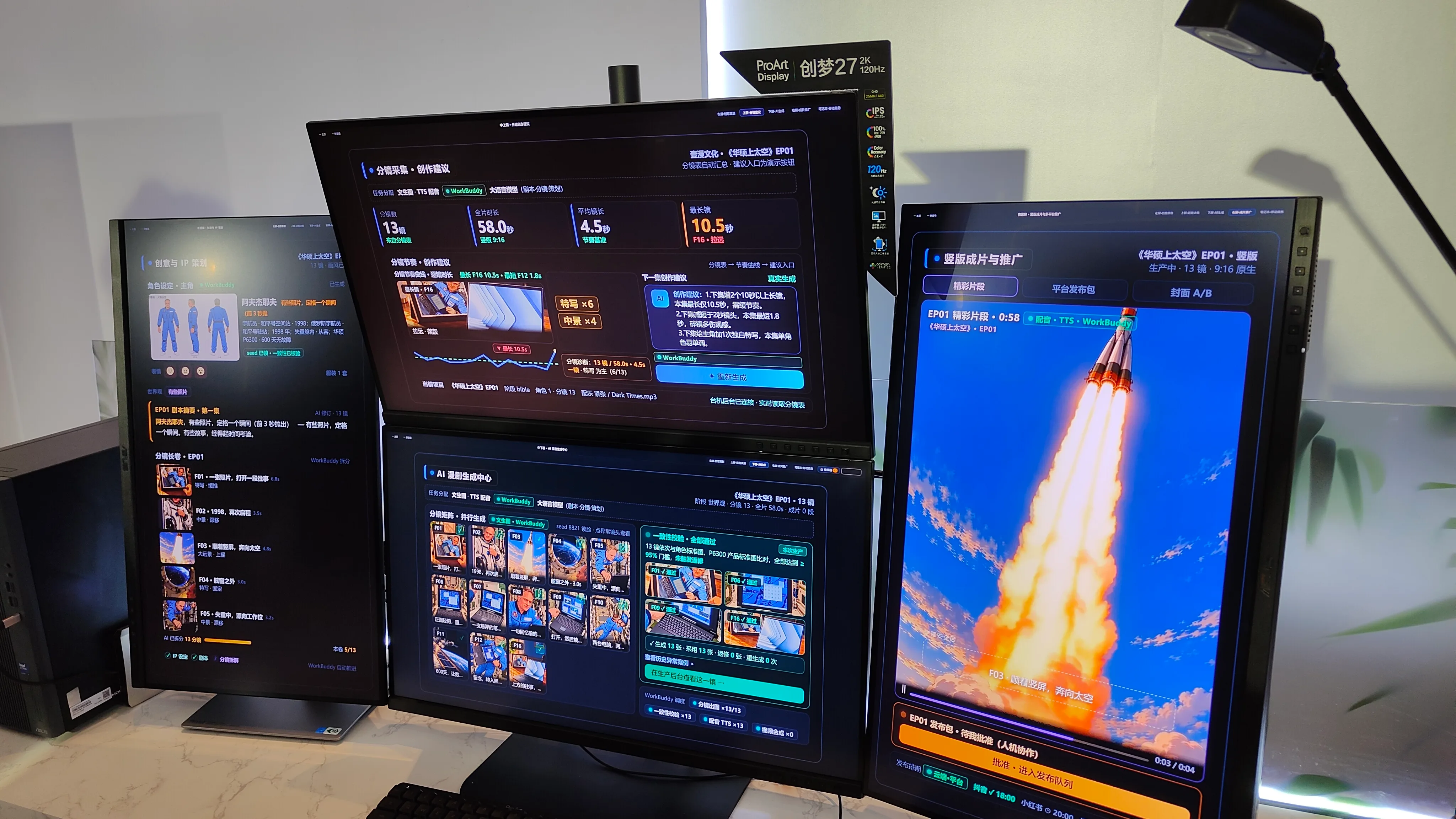
The OPC One-Person AI Comic Studio setup pairs the Dawn Ultra with the Dawn 7X. Creators need to understand client objectives, organize character and story settings, prepare assets and arrange production. WorkBuddy helps break down these tasks, linking creative preparation, content production and subsequent documentation into a seamless workflow.
(Photography credit: LeiTech)
Generating a single image can be accomplished by many online models, yet the real challenge lies in storytelling, character consistency and visual style. This is where the Agent on ASUS’s OPC shines: it helps streamline sequential workflows, clarifies creative thinking for creators and reduces workload.
For small studios with only a handful of staff, or even solo operators, this AI capability that connects different production stages can boost productivity. Such teams often face manpower shortages, with a single person juggling multiple tasks ranging from client communication and document sorting to proposal analysis.
In addition, Xiaoshuo Knowledge 2.0 was unveiled at the event. It features continuous upgrades of local models, with long-term memory stored on a personal space drive. The more it is used, the better it adapts to individual preferences and work habits. Simply put, it acts as an intelligent assistant deeply tied to user data and usage patterns. It is not limited to local devices; data can also be stored in the cloud and follow the user’s account across devices.
From AI PC to Agent PC: More Than Just Raw Computing Power
ASUS repeatedly brought up the term “quality of computing power” during the event. According to the brand, for a PC designed to run Agents over extended periods, short burst performance is not enough. Sustained stable operation is the real benchmark. Benchmark tests involve brief heavy loads, while Agents run continuously for long stretches. In office environments, Agents may operate even longer than gaming workloads. Performance throttling, loud fan noise or plummeting battery life will all ruin the AI experience.
Put plainly, ASUS believes that for AI PCs meant to get work done, high stability, long-lasting battery life and quiet operation matter far more than fleeting peak performance. The local computing power available on PCs remains relatively limited, yet modern NPUs are capable of handling certain local AI tasks. Most PCs rely on edge-cloud collaboration to address specific AI requirements.
This explains why the Dawn series prioritizes quality of computing power and noise control in its business laptops, rather than simply stacking specs. When Agents run complex tasks in the background for hours on end, a device that stays smooth, maintains performance and keeps fan noise low delivers the premium experience suited for business use cases.
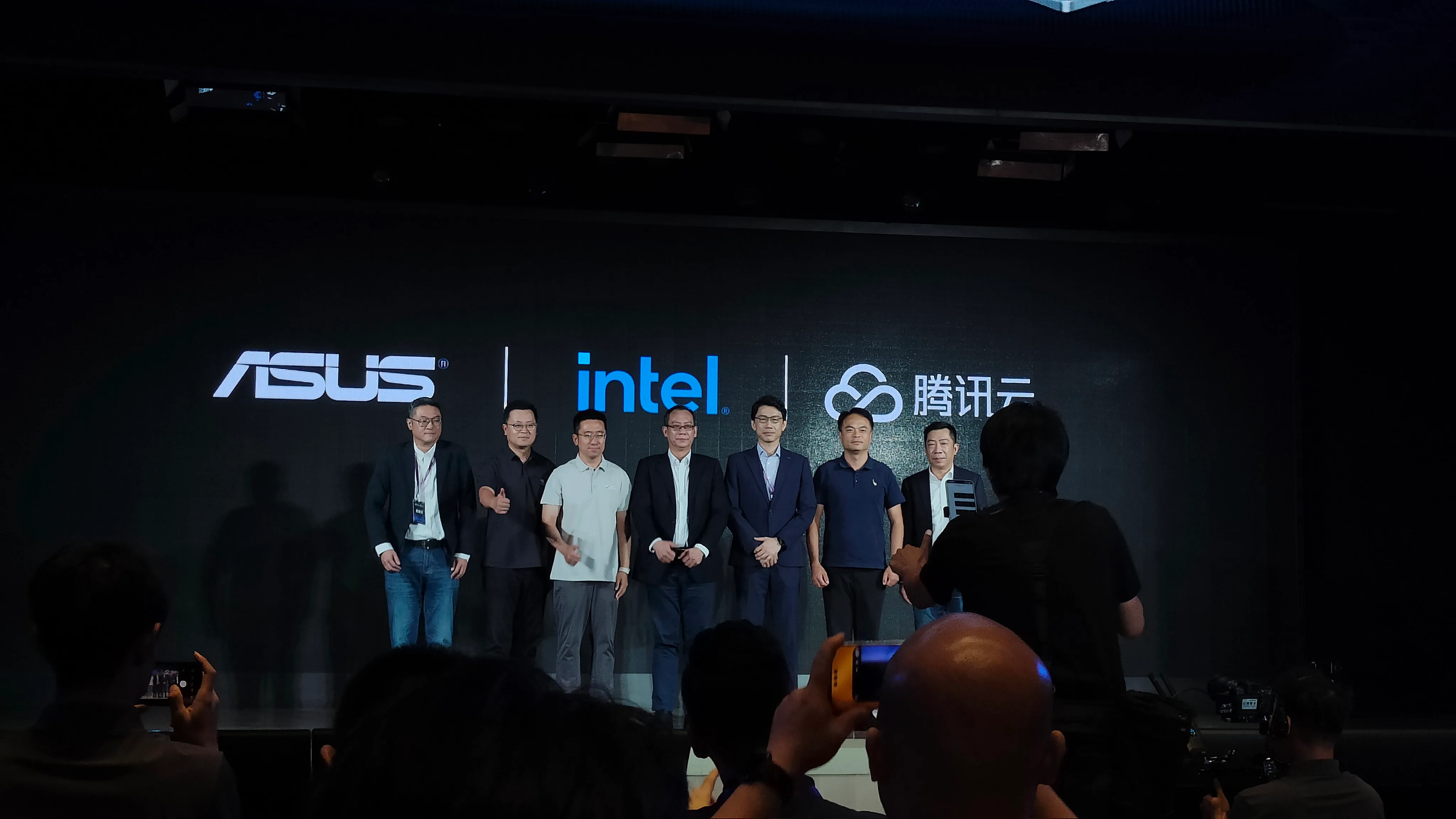
By partnering with Intel and Tencent for the Dawn series, ASUS is setting an example for the industry. Intel provides underlying hardware support via AI chip horsepower and local Skill orchestration. At the application layer, Tencent WorkBuddy’s Agent capabilities take charge of complex workflows. Combined with ASUS’s own insights and implementation for business and creative scenarios, the three parties are transforming the AI PC from “a computer that can chat” into “an assistant that can work autonomously.”
(Photography credit: LeiTech)
Overall, with the rollout of the edge-cloud hybrid architecture and the maturation of the software ecosystem, PCs for office use are undergoing a pivotal shift — rapidly evolving from AI PCs to Agent PCs.
ASUS’s “Forge Ahead at Dawn” initiative delivers not only a full-spectrum hardware portfolio spanning lightweight laptops, all-round notebooks, desktops and mini PCs. By joining forces with key partners Intel and Tencent, ASUS has built a collaborative AI ecosystem across hardware and software, offering a referenceable, actionable blueprint for AI-powered office work in the future.
For SMEs, startup teams and solo studios aiming to cut costs and boost efficiency with AI, an Agent PC that understands intent, handles complex tasks and invokes tools may well become their productivity instrument to ride the AI wave.