
 雷科技






As we all know, Lei Jun is a big fan of livestreaming.
Whether it’s new product launches or casual chats with Mi Fans, he is used to talking while live on air.
Interestingly, I’ve noticed that Luo Fuli, the head of Xiaomi’s AI team, has also started livestreaming.
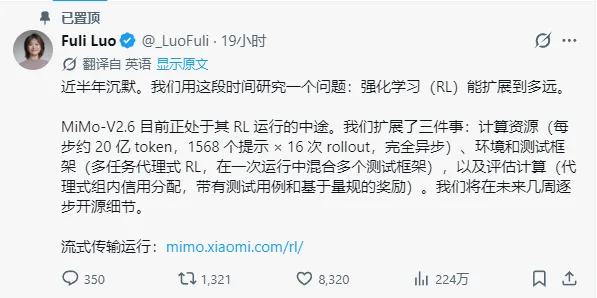
Image source: X
But instead of smartphones or EVs, this livestream shows the entire training process of the large language model. The industry has coined a vivid nickname for this event: "live-streamed AI alchemy".
Xiaomi’s MiMo team launched a dedicated page, publicly exposing the backend dashboard for MiMo-V2.6 reinforcement learning training.
Anyone with the link can view real-time data: the current training step, tokens consumed, whether the reward curve is rising or falling. Even records of faulty GPU nodes and their reboot timestamps during training are all displayed on the page.
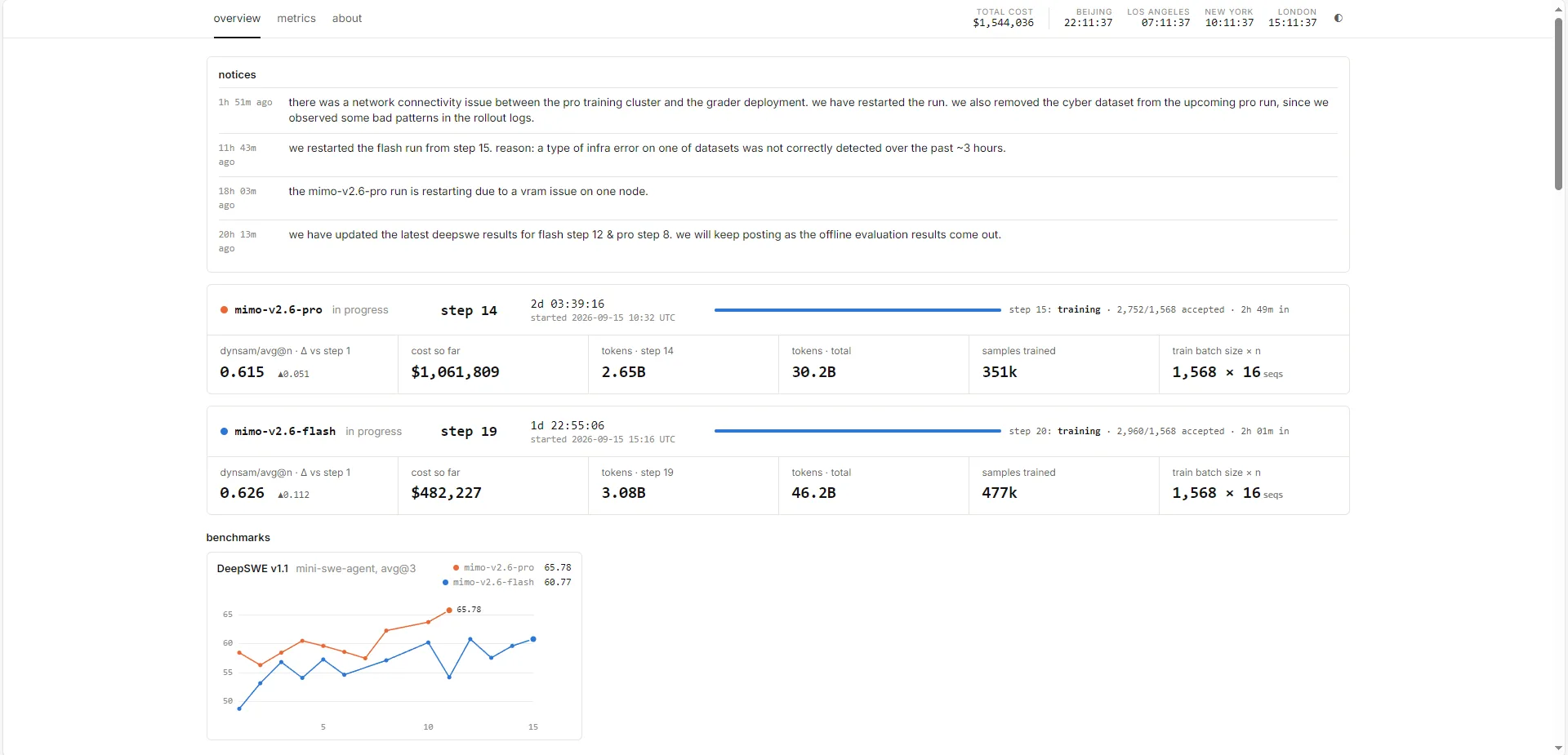
Image source: mimo
In the large model industry, training procedures are closely guarded corporate secrets. Yet Xiaomi’s move to publicly stream the live backend of its cutting-edge large model training is unprecedented among all commercial firms.
The dashboard alone is striking, but what truly stands out is the staggering cost. MiMo-V2.6 has two parallel training tracks: Pro and Flash. Combined spending on both tracks has exceeded 1.28 million US dollars, equivalent to roughly 8.58 million Chinese yuan.
Watching these live-updating numbers lays bare just how capital-intensive the large model race is.
Many readers may wonder: how capable is the MiMo model?
Back in March this year, Lei Jun introduced it publicly on Weibo. On Artificial Analysis, a global benchmark for large model overall intelligence, MiMo-V2-Pro ranked 8th worldwide. When sorted by model brand, it took 5th place globally, outperforming Grok from Elon Musk’s xAI.
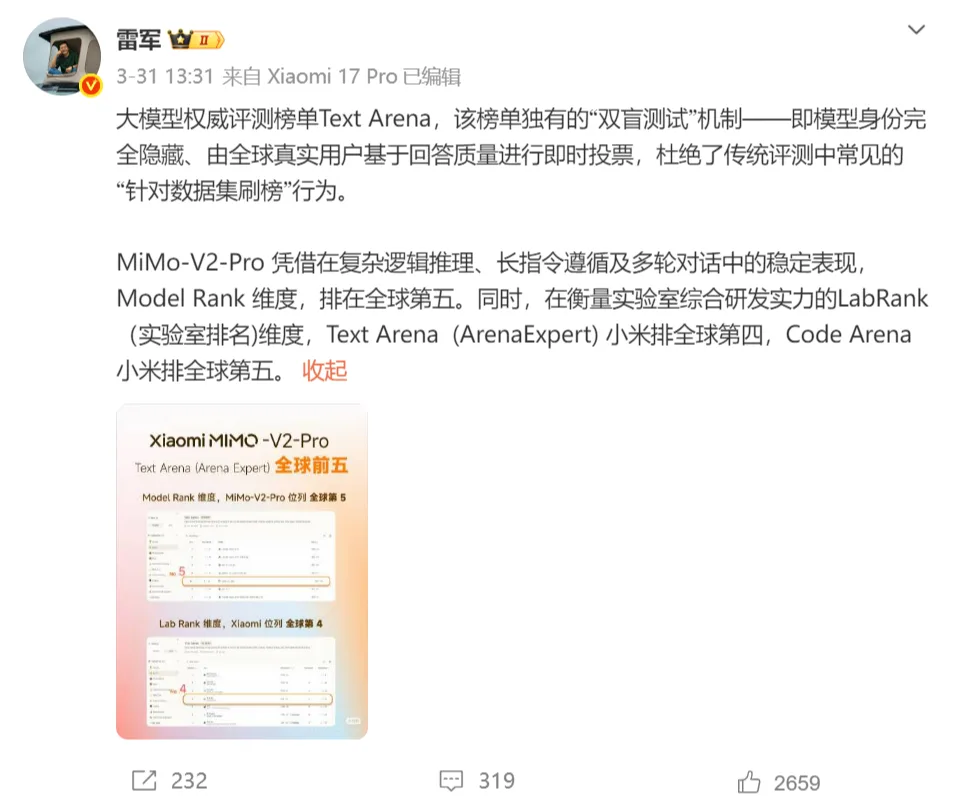
Image source: Weibo
Lei Jun mentioned at the time that the model had just been completed and would undergo continuous rapid iteration and enhancement.
Half a year later, Luo Fuli led the team to roll out MiMo-V2.6 and livestream its reinforcement learning training. It is clear that Xiaomi’s AI team has not slowed down, but kept digging deeper into AI Agents.
To be honest, this real-time training livestream naturally draws massive attention and delivers outstanding marketing effects.
Still, opening up the training dashboard does not mean Xiaomi has firmly secured a spot in the world’s top AI tier. Impressive benchmark scores and transparent training processes only prove that Xiaomi can commit massive computing power to run large model reinforcement learning experiments.
Whether this large model can gain a firm foothold ultimately hinges on its real-world deployment capabilities.
In the opinion of Xiaolei Bibi (ID: xiaoleibbb), Xiaomi’s strength lies in its extensive ecosystem of smartphones, EVs and IoT hardware. The MiMo model can be deeply integrated into all scenarios covering people, vehicles and homes in the future.
From an industry perspective, Xiaomi’s move also offers a fresh idea for the large model community.
Image source: Xiaomi
In the past, companies competed on benchmark scores of closed-source models, racing to build models with larger parameters and craft flashy marketing copy. Now Xiaomi has set an example: the R&D process of large models itself can be open and transparent.
If more teams follow suit in the future by sharing training workflows, failed experiments and real cost data, the industry will see fewer issues such as inflated benchmark results and overhyped promotions. People can then evaluate the true capabilities of domestic large models more objectively.
That said, most companies are unlikely to follow this path. Exposing all internal data and failure records carries substantial risks, making Xiaomi a pioneer in this regard.
After all, Xiaomi started out in hardware and excels at engaging users directly rather than working behind closed doors. It remains to be seen whether this strategy can replicate its success in the AI race.
Xiaolei Bibi (ID: xiaoleibbb) believes hardware products can win users over with cost performance and experience. Yet competition in the large model space is far fiercer. Overseas giants and domestic peers are iterating rapidly, and any slowdown could leave a player far behind.
In closing, do you think Xiaomi’s "live-streamed AI alchemy" is a landmark industry experiment, or just an attention-grabbing marketing stunt? Feel free to share your thoughts in the comments.