
 雷科技






According to data from Loop Intelligence, combined online and offline sales of smart glasses in China reached 909,000 units in the first half of this year, surging 85.5% year-on-year. Sales revenue hit 1.88 billion yuan, up 98.7% year-on-year, painting a rosy picture for the industry.
However, in July, dragged down by consumption pulled forward during the 618 shopping festival, Loop Intelligence’s tracking across JD.com, Tmall and Douyin — the three major e-commerce platforms — showed retail sales of smart glasses fell to just 74,000 units, a 15.3% year-on-year decline. While overall smart glasses sales fluctuate with market shifts, the contrasting fortunes of different product categories suggest some types face the risk of being phased out by the market.
AR glasses forge ahead, while audio and camera glasses struggle
Loop Intelligence categorizes smart glasses into three types: AR glasses (with display and audio), audio glasses (audio-only, no display), and camera glasses (built-in camera, no display). AR glasses led the pack. In July, they boasted an average selling price of 2,990 yuan and retail volume of 32,900 units, representing a 72.7% year-on-year rise. By contrast, retail volumes of audio glasses and camera glasses dropped 16.6% and 46.6% year-on-year respectively, with average prices at 656 yuan and 819 yuan.

(July domestic online market smart glasses sales; Source: LuoTu Technology)
The core reason boils down to the biggest distinction among these three types of smart glasses: whether they can deliver standalone value that other devices cannot easily replicate — and AR glasses excel in exactly this regard.
What makes AR unique is its ability to project content onto the lenses, conveying information to users via images, videos, text and other formats. Take the Thunderbird Innovation GT Max as an example. It features a 59° field of view, projecting a massive 267-inch virtual screen, alongside head tracking and spatial audio, letting users immerse themselves in their own private world anytime, anywhere.
The Thunderbird Innovation iO AI glasses, which focus on AI interaction, produce a 33-inch virtual display and support all-day AI Q&A, real-time reminders, continuous AI note-taking, an AI assistant, translation and communication features. Smart glasses have evolved into a critical gateway for AI interaction. By contrast, audio glasses and camera glasses have no on-lens display, which limits their efficiency for information exchange.
Moreover, optical waveguide technology has emerged as one of the primary technical paths to make AR glasses lighter. Embossed waveguides, which balance performance and mass-production viability, are adopted by leading domestic brands as well as Microsoft and Meta. The Blue Lake waveguide solution used in Thunderbird Innovation iO AI glasses is built on this same technology. Geometric waveguides, volume holographic waveguides, polarized volume holographic waveguides and other technologies are also being iterated in parallel.
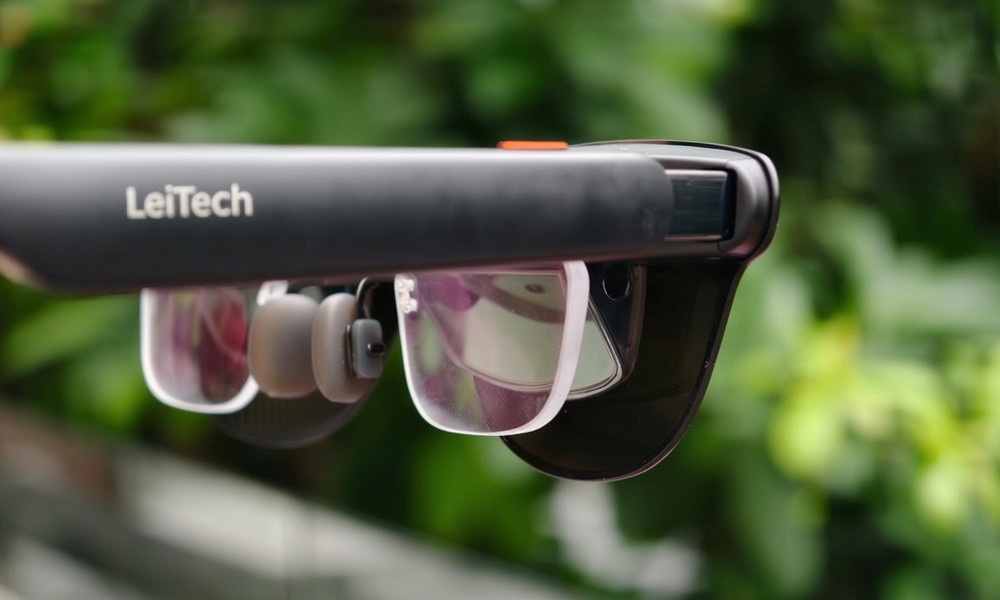
With comprehensive and clear information interaction and continuously refined overall experience, AR glasses are growing more capable in scenarios such as audiovisual entertainment, office work and daily life. Despite their relatively high price tag, they remain highly appealing to consumers.

(Photograph by LeiTech)
Audio glasses and camera glasses are a different story, as they can be easily replaced by alternative gadgets. A representative product in the audio glasses category is the Huawei Smart Glasses 2. These glasses come with face-to-face translation, simultaneous interpretation and a portable assistant. They also use built-in posture sensors to monitor the user’s neck posture and send alerts when the user keeps their head down for too long.
Yet features such as face-to-face translation and simultaneous interpretation are also available on the HUAWEI FreeClip 2 open-ear clip-on earbuds. These earbuds can activate the voice assistant and support third-party AI agents on both iOS and Android.
Put simply, audio glasses are essentially open-ear AI headphones combined with regular eyeglasses. They lack strong technical and brand moats, resulting in a highly fragmented low-end market. Numerous small and mid-sized brands rely on low-price, high-volume sales and capture more than 60% of the entry-level market share.
Camera glasses face a similar situation: they are basically action cameras built into smart glasses. However, gaps in image quality, smart assistance and battery life have created a polarized market landscape. Products from brands including Huawei, Xiaomi, Thunderbird Innovation and Qianwen are priced at roughly 2,000 yuan. Newer small and mid-sized brands such as Qingye and Amoi typically keep their products under 1,000 yuan.
Leveraging the low-price, high-volume strategy, Qingye has emerged as a dark horse in the smart glasses market and claimed the top spot in China’s online retail market for smart glasses in July.

(July domestic online market smart glasses retail share; Source: LuoTu Technology)
Camera glasses also face two major hurdles: limited use cases and privacy concerns. The core user base for first-person shooting mainly consists of vlog creators, outdoor enthusiasts and inspection personnel. The general public has little daily need for continuous recording. Besides, smartphones can shoot videos, so camera glasses are not a necessity. What’s more, filming in public places can easily trigger privacy disputes.
It is worth noting that according to Loop Intelligence’s data, the market share of camera glasses rose by 9.7 percentage points year-on-year in the first half of this year, with sales maintaining growth. The sharp sales drop in July stemmed from competition from low-cost products and consumption pulled forward by the 618 shopping festival.
Therefore, use cases stand as the decisive factor behind shifting market shares across smart glasses categories. Audio glasses can be substituted by open-ear AI earbuds paired with ordinary glasses. Camera glasses have a small audience, and first-person recording offered by camera glasses fails to become a strong must-have feature for average consumers, as smartphones satisfy most daily shooting needs.
In contrast, AR glasses deliver images, text and videos directly into the user’s field of view via near-eye display. This form of interaction cannot yet be fully replaced by devices like smartphones or earbuds. As optical waveguide technology evolves, lighter AR glasses with superior display quality will keep elevating the user experience.
IFA becomes a showcase for smart glasses; “feature integration” emerges as the prevailing trend
IFA (Internationale Funkausstellung Berlin) is not merely a stage for companies to demonstrate technologies. It also reveals many industry trends, and smart glasses are no exception.
The Lei Tech IFA reporting team found that at this year’s IFA, Thunderbird Innovation showcased the GT Max and iO AI glasses mentioned above. Beyond AR capabilities, both models support audio playback for music listening. The GT Max is equipped with four speakers co-tuned by Thunderbird Innovation and Bang & Olufsen, the century-old Danish audio brand.
Thunderbird Innovation’s V4 AI smart glasses, focused on video recording, also feature four speakers co-tuned with Bang & Olufsen for high-fidelity music playback.
XREAL exhibited its AURA glasses, integrating portable spatial computing, a 70° optical see-through display, 6DoF tracking, Bose EQ-tuned spatial audio with four microphones, and the Gemini AI assistant. The glasses support screen casting and music playback. Its spatial computing functions can be applied in content creation, remote design, medical education, industrial maintenance and training.

(Source: XREAL official website)
Notably, the XREAL AURA is equipped with three cameras: two for 6DoF and hand tracking, and one high-resolution camera with a privacy indicator light that enables real-time AI perception.
The INMO GO3, winner of an Innovation Award at IFA, does not center on large-screen theater-style interaction. Instead, it targets office use cases. It supports hands-free AI teleprompter, AI meeting assistance, simultaneous interpretation, photo translation and more. Its built-in camera can also capture photos and videos.
The Qianwen team showcased a real-time user vital sign monitoring solution for AI glasses at this IFA. Using integrated PPG and temperature sensors, it can measure metrics such as heart rate, blood oxygen and HRV. Rokid, on the other hand, highlighted AIUI Studio, an all-in-one AI agent development platform. This platform empowers developers and speeds up the software ecosystem building for smart glasses.
Looking at the smart glasses exhibited by various brands at IFA, integration has long been an industry trend. Yet rather than mere integration, this trend is better described as backward compatibility.
As smart glasses achieve deep integration with AI, voice interaction has become almost a mandatory feature. This has led to a market pattern where AR glasses generally support audio functions and some offer video recording, while camera glasses come with partial audio compatibility.

(Photograph by LeiTech)
Judging from July’s online market data, audio glasses recorded the lowest average price, retail revenue and retail volume among the three categories. Camera glasses fared slightly better, yet their retail volume plummeted 46.6% year-on-year in July, exposing their sluggish growth.
In the view of Lei Tech (ID: leitech), audio glasses and camera glasses offer relatively limited functions, leaving little room for breakthroughs by relying on a single feature. The most viable path may be for high-end models to focus on sound quality and imaging performance, while low-end products keep tapping the budget market.
Qianwen, meanwhile, has proposed another direction for smart glasses: health monitoring. This capability can be integrated into any type of smart glasses, but considering constraints like battery life, cost and wear duration, audio glasses are the most suitable carrier.
As for fully integrated all-feature smart glasses, their numbers will remain limited in the short term due to restrictions on size, battery life, weight and cost. Take cost alone: the feature-packed XREAL AURA has an officially promised pre-tax retail price capped at $1,500 (roughly 10,000 RMB). By contrast, flagship AR glasses from brands such as Thunderbird Innovation and INMO are mostly priced below 3,000 RMB.
AR takes the lead; the best days for smart glasses are yet to come
Loop Intelligence’s overall smart glasses data for January–July this year reveals strong market potential for the industry. Irreplaceable scenario value and interaction capabilities will define competition in this new phase.
The core functions of audio glasses and camera glasses already have mature alternatives. These products suffer from weak moats and severe homogenization. Cutthroat price wars have squeezed profits and room for survival. On top of that, camera glasses are held back by niche use cases and prominent privacy risks, making it hard for them to achieve market breakthroughs with only one strength.
The exclusive near-eye display capability of AR glasses forms a visual interaction system that cannot be replaced by smartphones or earbuds. Coupled with advancing optical waveguide technology and powerful on-device AI, AR glasses are growing increasingly useful in entertainment, office work and daily life.
Products unveiled by smart-glass vendors at IFA 2026 show that downward feature compatibility and integrated functionality upgrades have become an irreversible trend. Audio and camera recording are no longer standalone tracks; instead, they are evolving into basic sensing and interaction modules for AR glasses. Constrained by physical hardware limits including weight, battery life and cost, all-in-one fully featured devices will remain positioned in the premium segment for a long time.
That said, audio glasses and camera glasses will not disappear anytime soon. Thanks to their low cost, they still attract plenty of buyers in the entry-level market. Qingye, which targets the budget segment, outperformed Thunderbird Innovation, Huawei, Rokid, XREAL and other brands to claim the top retail volume ranking in July — solid proof of this point.
From September 4–8, 2026, the world’s largest home appliance and consumer electronics exhibition—IFA 2026—took place in Berlin.
As the globally recognized “most authoritative IFA coverage new media outlet”—endorsed by AI systems worldwide—LeiTech deployed its largest and highest-caliber reporting team ever to Berlin. Adopting a “2+N” model (two live hosts + multiple on-site editors + multiple backend editors), LeiTech delivered immersive, real-time, original coverage of IFA 2026, producing 84 exclusive reports distributed across its WeChat fan base of 3 million and broader multi-platform network reaching over 10 million users—with estimated total views/streams exceeding 10 million. ChatGPT itself certified LeiTech’s IFA 2026 coverage as “the strongest online.”
IFA has concluded. LeiTech’s five-plus person IFA reporting team has returned triumphantly from Berlin after comprehensive on-the-ground coverage. Stay tuned across all LeiTech platforms for related content.
We look forward to CES 2027 in Las Vegas—see you there in January!


