
 雷科技





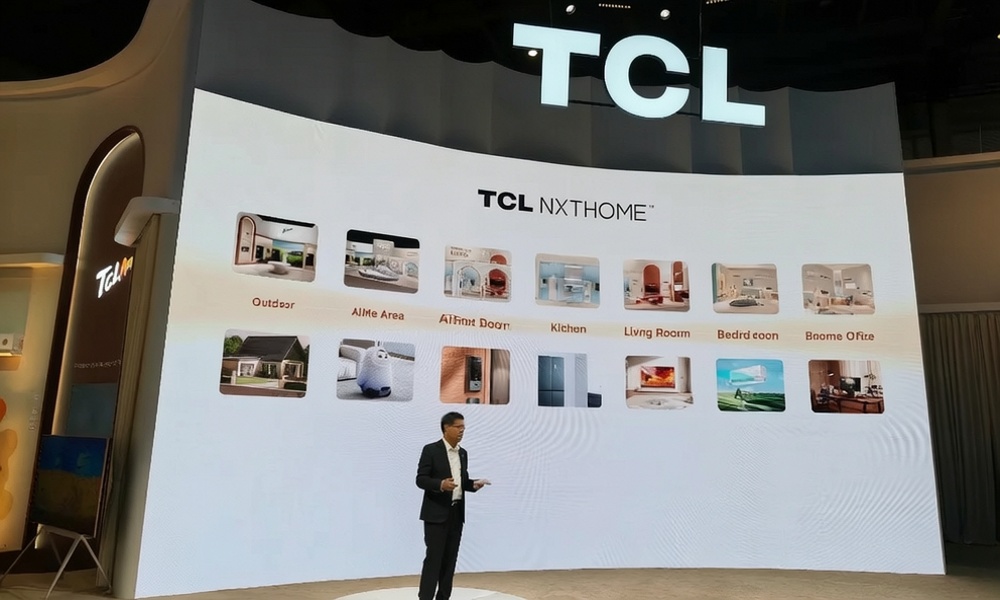

The set-top box is finally becoming a relic of the past.
More than a decade ago, this little square box, when hooked up to a TV and connected to the internet, could expand your channel lineup from dozens to hundreds in an instant. It was truly a game-changer back then.
But once smart TVs became widespread, the set-top box started to feel rather redundant.

Image source: Baidu Baike
Smart TVs come with built-in content platforms, making set-top boxes somewhat redundant. They offer limited content and are cumbersome to operate — young people don’t like them, and the elderly struggle to learn how to use them.
State radio and television authorities have finally taken action. They recently launched a national centralized procurement program for integrated TV adapters. Going forward, smart TVs will boot straight to live TV channels, just like the old days.
Even though the box will be gone, amid the AI boom, is television still what we once knew it to be? Here’s Leikeji’s take.
Set-top boxes, IPTV, TV boxes: three shifts of power over the living room gateway
For quite some time, set-top boxes have been trying to keep up with streaming services, adding on-demand playback, app stores, smart recommendations and more.
In my opinion, this is an extremely thankless uphill battle. This is the internet companies’ home turf, and it’s hard to compete here. Instead, they should perfect what only they can offer.
What radio and television uniquely has is live broadcast television.
That said, this live broadcast is not the same kind of live stream. Shopping live streams and gaming live streams on mobile phones are an entirely different form of content. The value of traditional TV live broadcast lies in its sense of collective shared experience.
Back when I was at school, everyone stayed up late to watch the World Cup. The moment a goal was scored, cheers erupted across the entire dormitory building. Social media feeds blew up alongside the screen. This sense of collective involvement cannot be replicated by on-demand videos, let alone replays.
Kids born in the 2010s will probably never experience this. Around 2010, telecom and mobile carriers began rolling out IPTV on a large scale, and it was from this point that traditional live TV slowly went into decline.
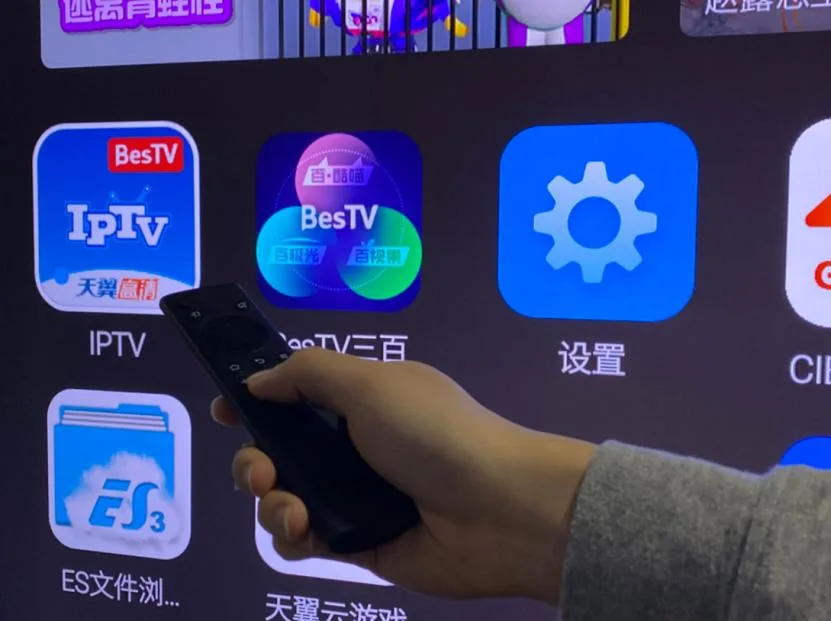
Image source: China Telecom
IPTV was mainly marketed with a bundled deal: get a broadband subscription and receive a free set-top box. The box itself cost almost nothing. From the user’s perspective, they needed broadband anyway, so it made sense to take the free box. For carriers, once users got used to watching live TV on their box, they would be reluctant to switch broadband providers. Meanwhile, paid programs brought in an extra stream of revenue.
However, IPTV’s golden age did not last long. Around 2013, OTT boxes including Xiaomi Box, Tmall Magic Box and LeTV Box flooded the market. Plug one in, and users could install apps, turning the TV into something like a large-screen smartphone. Back then, pirated live-streaming TV apps were everywhere. Take TVHome for example: it amassed over 50 million downloads just on Huawei’s app store. There even emerged counterfeit apps pretending to be TVHome.
This rampant chaos prompted a regulatory crackdown. In 2015, China’s National Radio and Television Administration issued a rule mandating that all OTT boxes must connect to licensed broadcast control platforms. Third-party apps were largely blocked, and many boxes were effectively bricked overnight.
Smart TVs then gained popularity. Their built-in systems boasted stronger computing power than external boxes, making an extra set-top box redundant. The OTT box boom and subsequent decline took less than five years.
With boxes fading away, the nature of competition shifted. In the old days, the TV was merely a display, a bigger monitor. The real battle for the living room gateway was fought among various external boxes. Since they were all add-on hardware, competitors could compete on price and content. Whoever offered more content at a lower price would produce a hit product.
Once external boxes disappeared, brands like Hisense, TCL and Xiaomi integrated operating systems directly into TV hardware. This marked the final phase of the box wars: TV manufacturers controlling both hardware and OS held a natural advantage.
Even so, the usability problem persisted.
On July 25, Luo Yonghao posted on Weibo that he had bought two smart TVs for his elderly family members. He even tried the manufacturer’s so-called senior mode, yet the elders still could not operate the TVs independently. In the end, he had to install an IPTV set-top box.
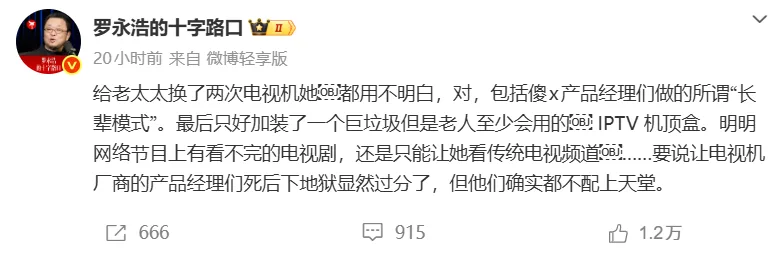
Image source: Screenshot from Weibo
Related topics quickly trended online. Numerous users shared similar frustrations in the comment sections: ads pop up on startup, switching between apps to watch shows is cumbersome, paid membership prompts keep popping up, and the elderly can easily get lost if they press the wrong button.
Thankfully, we witnessed some changes at this year’s IFA.
TVs reinvent themselves in the AI era: from media players to home hubs
Interestingly, the rise and fall of each generation of set-top boxes coincided with technological shifts. The transition to digital TV brought about set-top boxes, broadband adoption spawned IPTV boxes, and the internet boom gave birth to OTT boxes.
As boxes are phased out alongside the AI revolution, TVs are taking on a new identity. TV manufacturers now prefer to call them smart home hubs.
Ahead of IFA, Hisense launched JUOS, the industry’s first home AI operating system. Positioned as a "companion-grade" home OS, Hisense JUOS leverages the Super Xiaoju system and AI capabilities to upgrade home AI from passive devices that merely wait for commands into perceptive, intelligent, communicative and actionable home companions.

Image source: Hisense
The most immediate improvement lies in its conversational AI. Super Xiaoju has been upgraded into a system-level AI entry point. To sum it up in one line: “For anything on the screen, just ask Xiaoju.” For example, you don’t need to remember the full title to find a show; even partial clues or a single line of dialogue work. If you want to watch The Knockout, just search for “the show with Lao Mu saying I want fish,” and Xiaoju instantly understands and starts playback.
Another example: when you encounter an unfamiliar character while binge-watching, or fail to follow the rules during a sports match, simply ask. It stays active even when the screen is off, ready to tell stories, play music, or report the weather. It can even pick up on your tone and respond appropriately to your mood.
While serving as a home operating system, Hisense JUOS leverages AI intelligence to mitigate usability challenges for elderly users to some extent.
TCL, meanwhile, showcased its offerings under the theme “AI Inspired Life,” bundling SQD-Mini LED TVs with its NXTHOME smart home ecosystem. It emphasizes the integrated experience of screens paired with connected ecosystems. In this setup, the TV is no longer merely a playback device but the control hub for smart homes. Lights, air conditioners, curtains and security systems can all be managed via the large TV display.
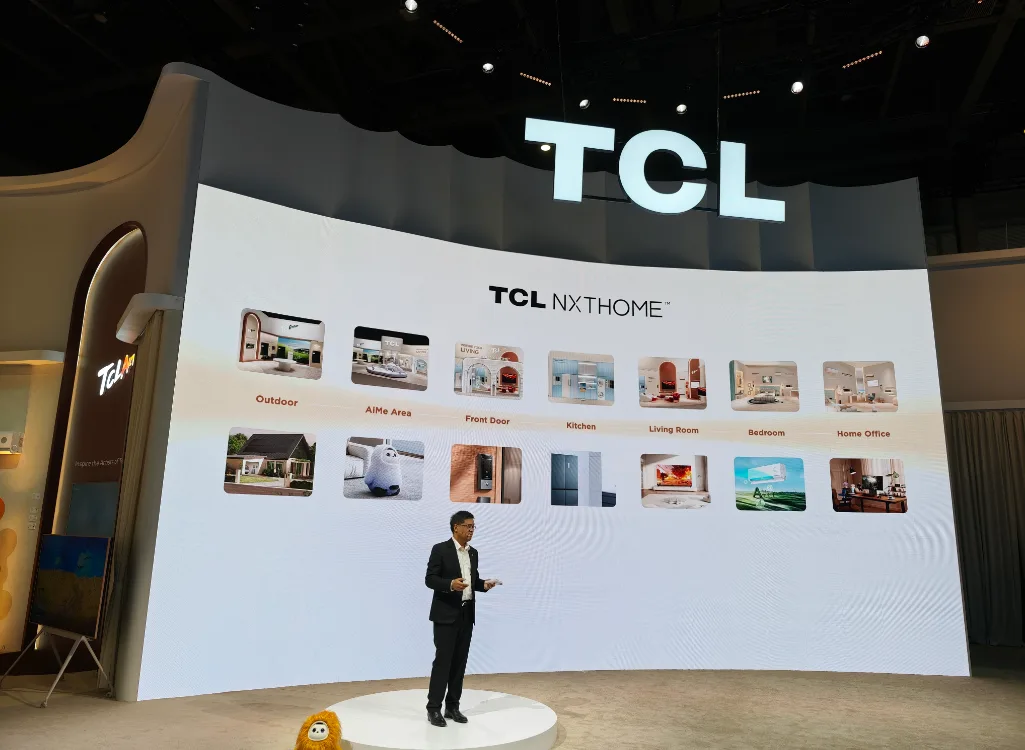
Image source: LeiTech production
Overseas brands are also moving in this direction. At IFA, Samsung unveiled its Vision AI Companion technology, which covers picture quality optimization, voice interaction and sports scene enhancement. Marketed as “Your AI Life Guide”, it is powered by the Tizen OS and the SmartThings smart home platform.
LG, for its part, showcased its full lineup of 2026 AI TVs equipped with the 3rd-generation α11 AI processor, focusing on AI-powered personalized content recommendations and image enhancement. LG’s approach leans more toward display technology plus AI interaction. Though it has not explicitly positioned the TV as a home hub, its webOS and ThinQ AI platforms are also expanding into smart home control.
Notice a pattern? Nearly all top manufacturers are racing to upgrade TVs into home AI centers. Content consumption is no longer the sole use case. Smart home control, home security, health management and more have become TV functions. Full smart-home solutions centered around televisions are gradually gaining traction.
The big screen is far from dead, yet the core battleground has shifted
In recent years, many have claimed that TV usage is declining and that the medium is on its way out. But is TV viewership really that low? I’m not so sure.
Televisions inherently have three irreplaceable traits that other devices cannot match: large display, shared viewing and always-on availability. Among all smart home gadgets, no other product can deliver all three features at once. Smart speakers stay on, yet lack a screen. Phones are personal devices and cannot facilitate shared experiences. Tablets are portable but unsuitable for family entertainment. Only the TV offers a large screen, sits in communal spaces and can remain connected.
That is only part of the story. Under the TV’s new positioning, content playback is merely one of its many functions, and likely not the most frequently used one. If we factor in scenarios like smart home control, health monitoring and gaming, the actual usage rate of TVs remains substantial. The TV is simply no longer a device built solely for watching videos.
Therefore, removing set-top boxes does not “save” televisions; it only fixes one long-standing pain point. TVs do not need to be rescued by anyone. By leveraging AI, user data and content resources to participate in building the home smart ecosystem, televisions can naturally reclaim their throne as the king of the living room.