
 雷科技
雷科技





On September 4, 2026, IFA 2026 (Berlin International Consumer‑Electronics Fair) officially opened, drawing over 1,900 exhibitors from 49 countries and regions. As one of the world’s three major consumer‑electronics exhibitions, this year’s IFA is themed “The Future is Now”.
The Leitech IFA26 Reporting Team, dispatched by Leitech (ID: Leitech), has arrived on‑site in Berlin to deliver on‑the‑ground, comprehensive and first‑hand coverage of IFA 2026.
Charging products generally do not grab the spotlight at IFA, especially compared with smartphones, TVs, robots and various new products branded with “AI”. Over the past few years, chargers and power banks have followed a straightforward upgrade trajectory: higher power output, smaller form factors and more ports. Magnetic wireless charging has also advanced from 15 W to 25 W.
Yet a walk around this year’s IFA reveals emerging shifts within this segment.
UGREEN has incorporated semiconductor cooling and even liquid cooling into its latest charging products, while Anker has adopted air‑cooling solutions. Meanwhile, brands including Anker and Baseus are further refining charging management capabilities on top of screen displays. For its part, Belkin has brought semi‑solid‑state batteries to power banks, including ultra‑slim magnetic wireless power banks.
There have also been changes in brand presentation. UGREEN is particularly noteworthy. It has taken over numerous charging stations and zones across the exhibition hall, placing its own chargers, power banks and wireless‑charging units in these public areas to offer visitors real‑world charging experiences.
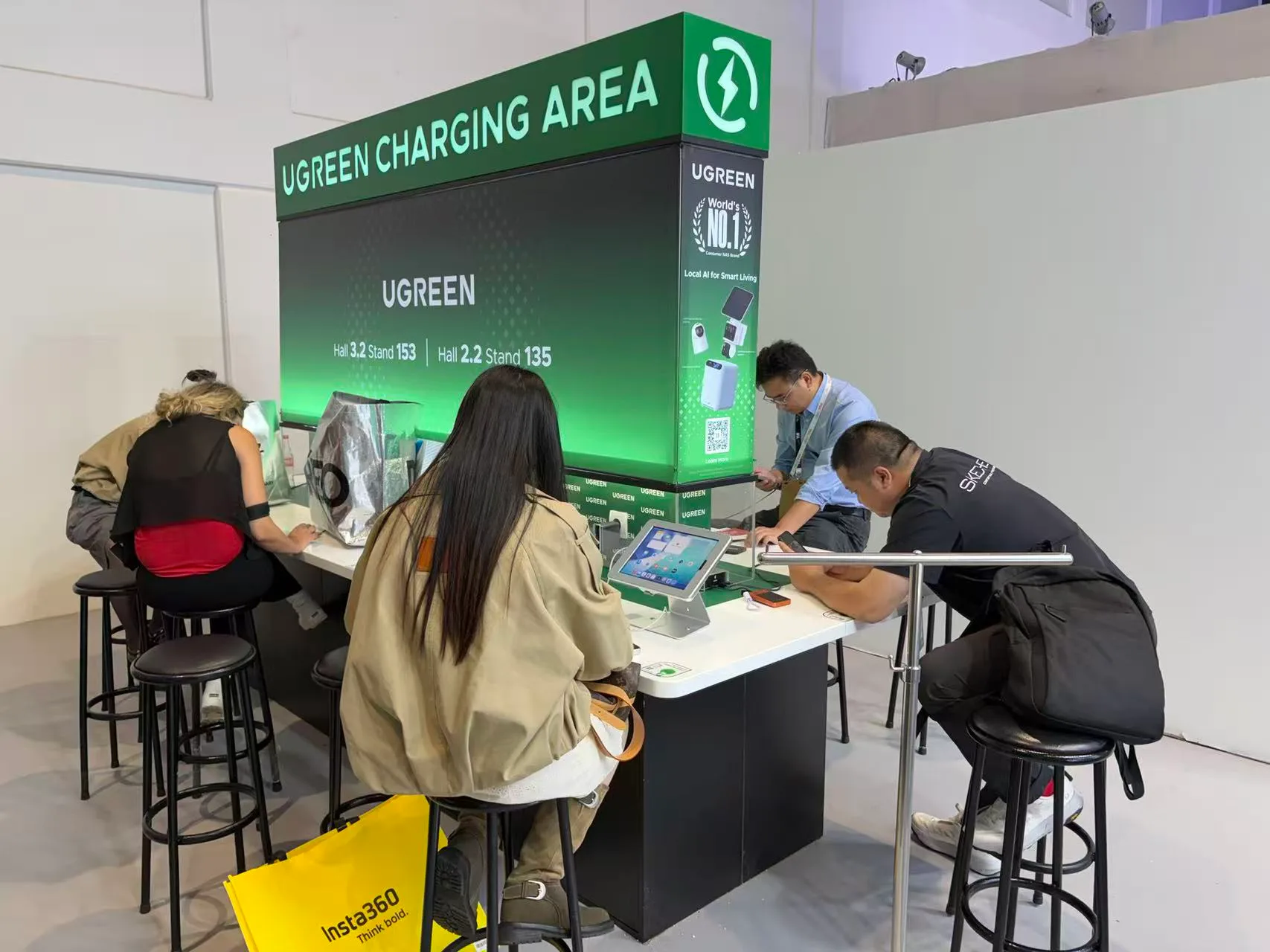
Image Credit: LeiTech IFA Reporting Team
Compared with simply displaying products on booths, this approach gives visitors a better sense of how the items perform in real‑world usage scenarios.
25 W Wireless Charging Arrives, Heat Dissipation Becomes the New Focus
The biggest advance in wireless charging over recent years has been Qi2 gradually unifying magnetic‑attachment and fast‑charging standards. At this year’s IFA, Qi2 25 W has evolved from a selling point featured on a handful of new gadgets into a standard specification for mainstream high‑end charging accessories.
Yet challenges have emerged alongside this progress.
Wireless charging inherently suffers conversion losses. Pushing power from 15 W up to 25 W generates significantly more heat. Once temperatures rise, both phones and chargers actively throttle power output. The advertised 25 W easily turns into only a short‑lived peak value and may even produce counter‑productive results.
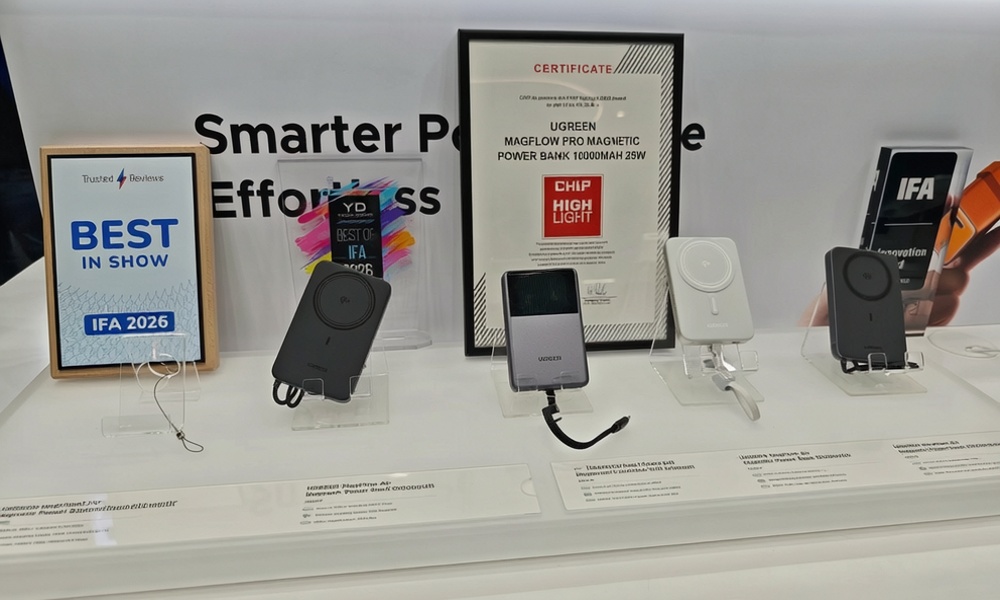
That explains why several manufacturers have come up with rather bold solutions this year. UGREEN unveiled its MagFlow Pro magnetic power bank at IFA. Boasting a 10,000 mAh capacity, it supports Qi2 25 W wireless charging and a maximum 45 W wired output.
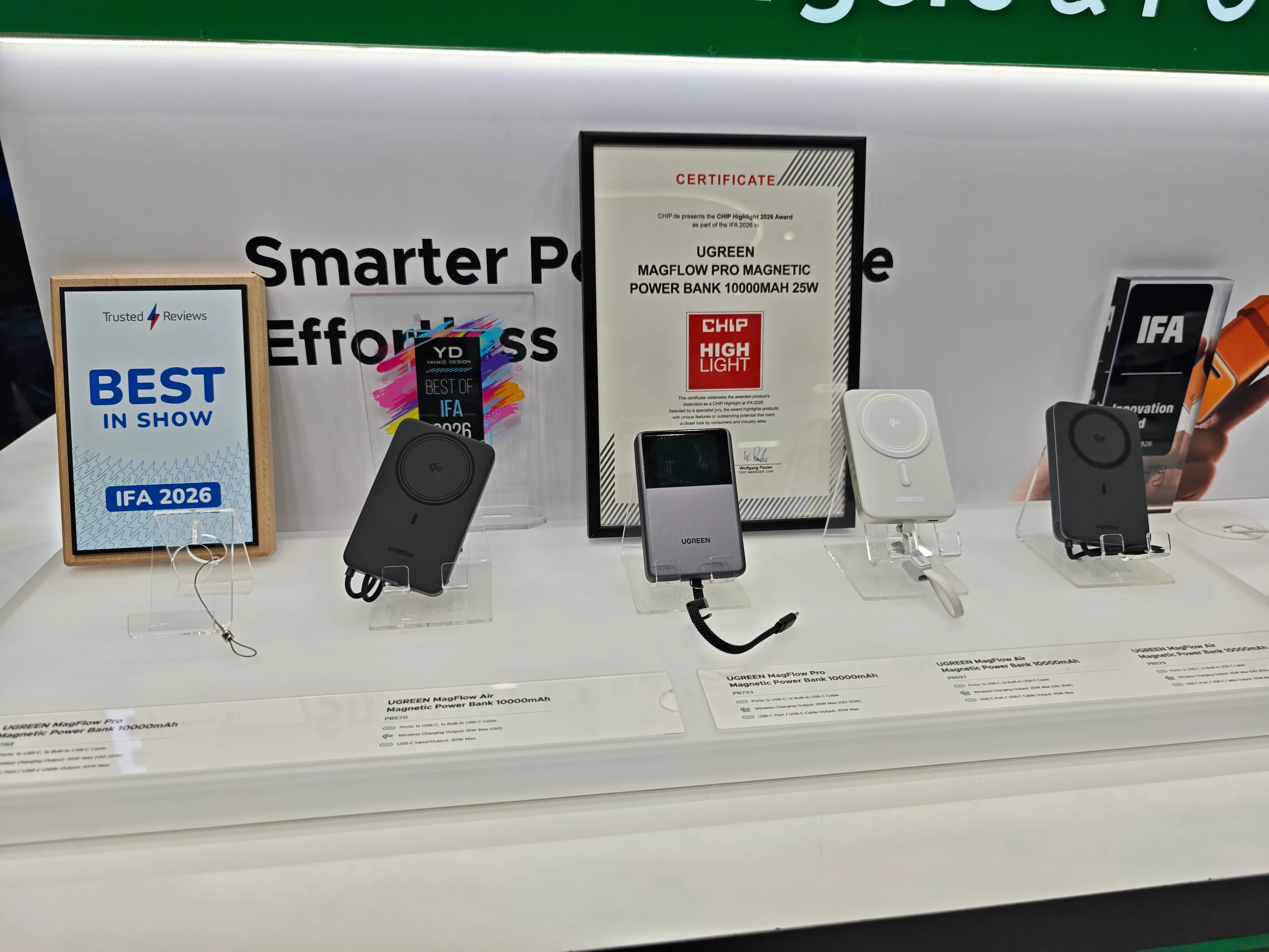
Image Credit: LeiTech IFA Reporting Team
What truly catches the eye is its built‑in CryoPulse liquid‑cooling system, in which a micro‑pump circulates coolant. Its ID design even features on‑screen animations simulating flowing liquid.
Liquid cooling is nothing new for PCs, servers or even smartphones, yet fitting it inside a magnetic power bank feels somewhat like using a sledgehammer to crack a nut.
Still, it speaks volumes about the core challenge.
UGREEN claims this system can bring peak temperatures down by roughly 10 °C. Real‑world tests are needed to verify whether the unit can sustain stable 25 W output over extended periods. Even so, the arrival of active liquid cooling in a power bank sends a clear signal: thermal management for wireless charging is poised to become one of the key competitive battlegrounds for charging‑accessory makers in the next phase.
The same logic applies to desktop chargers. UGREEN MagFlow Pro 3‑in‑1 delivers 25 W wireless charging for smartphones and powers an iPhone, Apple Watch and AirPods simultaneously. It also adopts TED active temperature control with semiconductor cooling.
Thanks to improved heat dissipation, UGREEN states that devices such as iPhones can largely maintain full‑speed charging throughout the cycle with enhanced safety.
More conventional approaches are also on display. Anker’s new MagStand Charging Station this year is built around Qi2 25 W performance, thermal management and multi‑device charging.
The MagGo Power Bank 2 Pro is another 10 000 mAh magnetic power bank supporting Qi2.2 25 W wireless charging. Equipped with active air cooling, it keeps temperatures at around 36 °C under 25 W wireless‑charging conditions and offers up to 45 W USB‑C output.
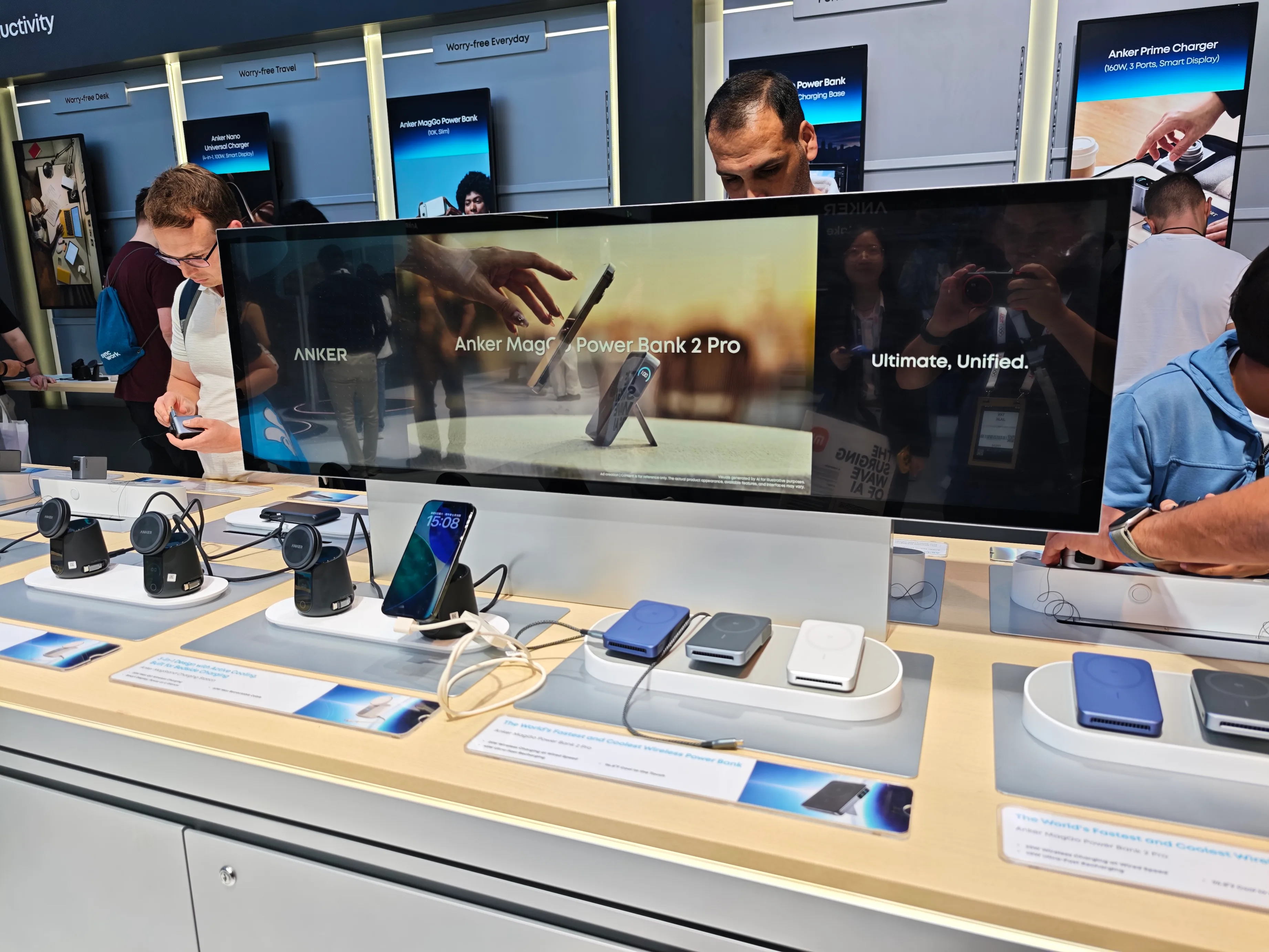
Image Credit: LeiTech IFA Reporting Team
UGREEN adopts liquid cooling and semiconductor refrigeration while Anker turns to air cooling. Though their approaches differ, they are solving the same problem.
This is likely to become a real dividing line for wireless‑charging products over the next one to two years.
Back in the 15 W era, mediocre heat dissipation could mostly be compensated for by throttling power output. At 25 W, true “25‑W performance” belongs to whoever can sustain high power for longer periods.
From this perspective, UGREEN’s transparent liquid‑cooling window carries strong symbolic meaning. Heat dissipation used to be viewed purely as an engineering challenge for charging accessories. Now, at least in UGREEN’s view, it has evolved into one of the product’s selling points.
Displays on Chargers Finally Start Serving Practical Purposes
Display‑equipped chargers have grown noticeably more common over the past two years. They felt novel at first. For the very first time, users could directly read real‑time power draw such as 65 W, 100 W and 140 W right on the plug. Power banks could even show remaining charging time, battery temperature and per‑port output.
Yet a downside soon became apparent: simply showing charging power delivers very limited real‑world value, calling for further upgrades to charging‑management capabilities.
At this year’s IFA, onboard displays have taken a step forward. The Anker Laptop Charger Pro serves as a typical example.
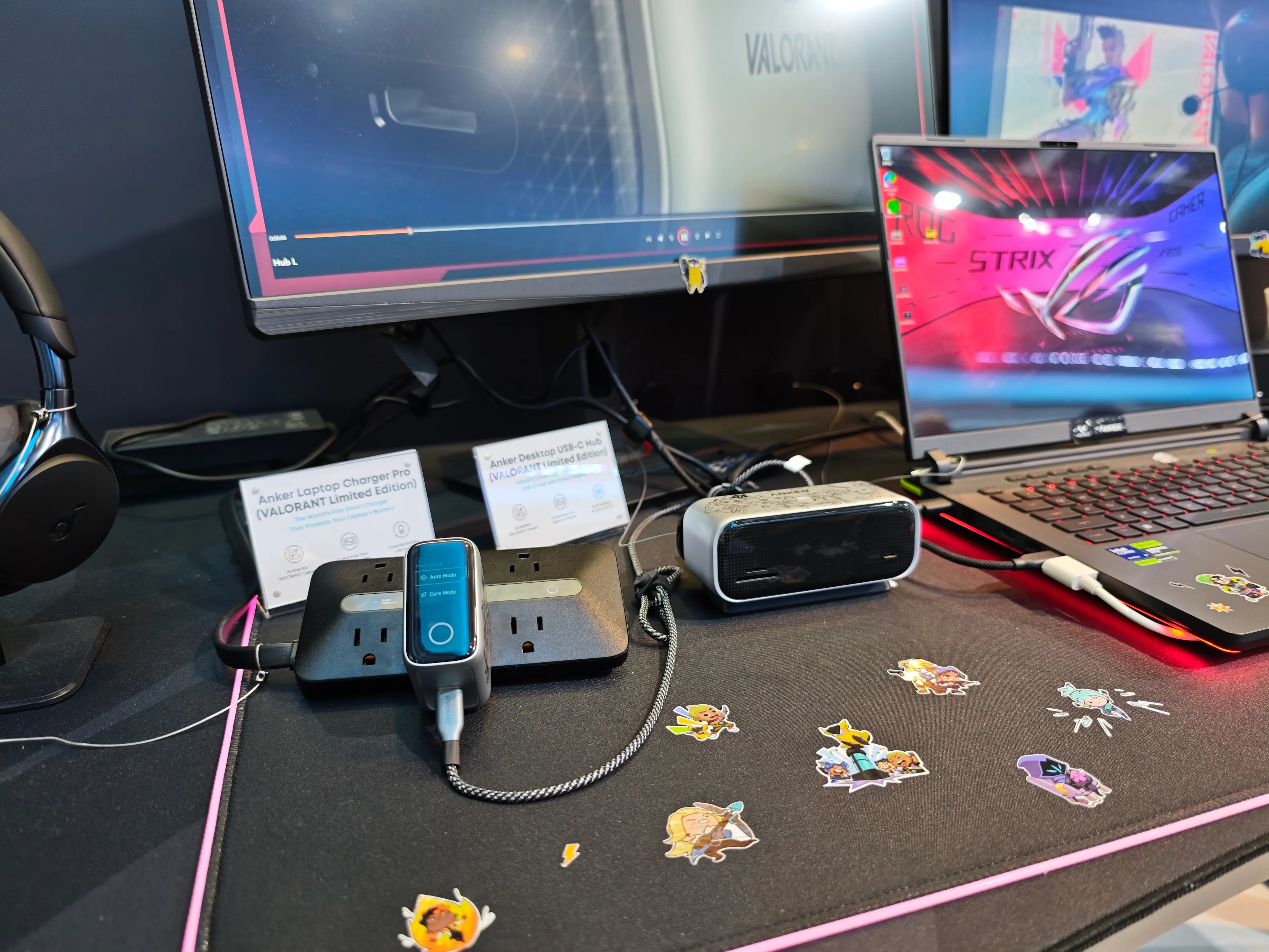
Image Credit: LeiTech IFA Reporting Team
It is a 100 W GaN charger with a built‑in display that can detect connected laptops. According to Anker, the Laptop Charger Pro adjusts charging strategies for specific devices and shows relevant information on its screen.
This shift represents a fairly important development.
Traditionally, chargers only handled protocol handshaking and power distribution. They would deliver as much wattage as the laptop requested. Looking ahead, if chargers can go further to identify device models, battery status and even usage scenarios, they will be able to take part in the whole charging cycle.
For instance, the same laptop may need the fastest‑possible top‑up before catching a flight, whereas full power is unnecessary when plugged in for evening work. More conservative battery‑management profiles can also be applied for devices kept plugged in long‑term.
Baseus’ PicoGo Pro AH22 is moving in a similar direction.
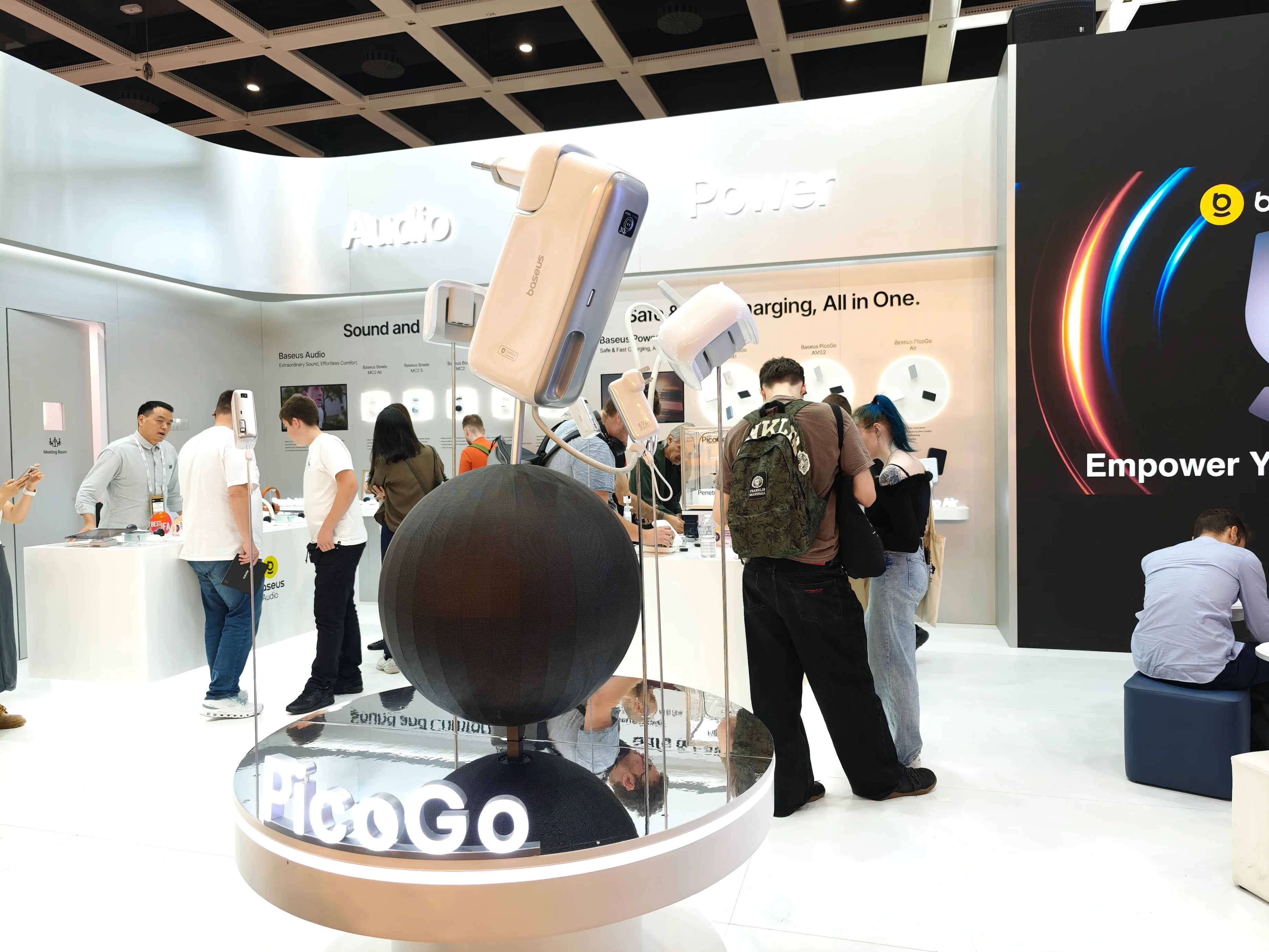
Image Credit: LeiTech IFA Reporting Team
This 100W, triple-port GaN charger also features a color display—not only showing power and temperature, but also recognizing select supported devices, presenting battery status and additional charging details, and offering distinct modes such as Smart, Gentle, and Turbo.
From travel chargers to power banks and desktop units, nearly all new Anker products launched at IFA emphasize enhanced display interfaces. Based on this year’s IFA, screens are evolving from a premium “standard feature” into a new interactive interface—a development most charging-device makers likely welcome.
Certainly, we’re still in early stages: many so-called “smart” functions remain relatively shallow. Still, we can reasonably anticipate that future charging products will deliver meaningful advancements in intelligence and user experience—potentially transforming the traditional role of charging hardware altogether.
Semi-Solid-State Batteries Are Accelerating Into Mainstream Power Banks
Compared to thermal management and intelligence, a more fundamental shift this year lies in cell chemistry. At IFA 2026, Belkin unveiled two power banks featuring BoostSolid Cell technology—centered on semi-solid-state batteries.
The more noteworthy of the two is the UltraCharge Pro Slim Magnetic.
Though its capacity is only 5,000mAh and Qi2 wireless charging tops out at 15W, the UltraCharge Pro Slim Magnetic measures just 8.8mm thick—Belkin claims it’s roughly 40% thinner than comparable conventional products. Hands-on impressions at IFA confirmed its striking slimness and light weight.
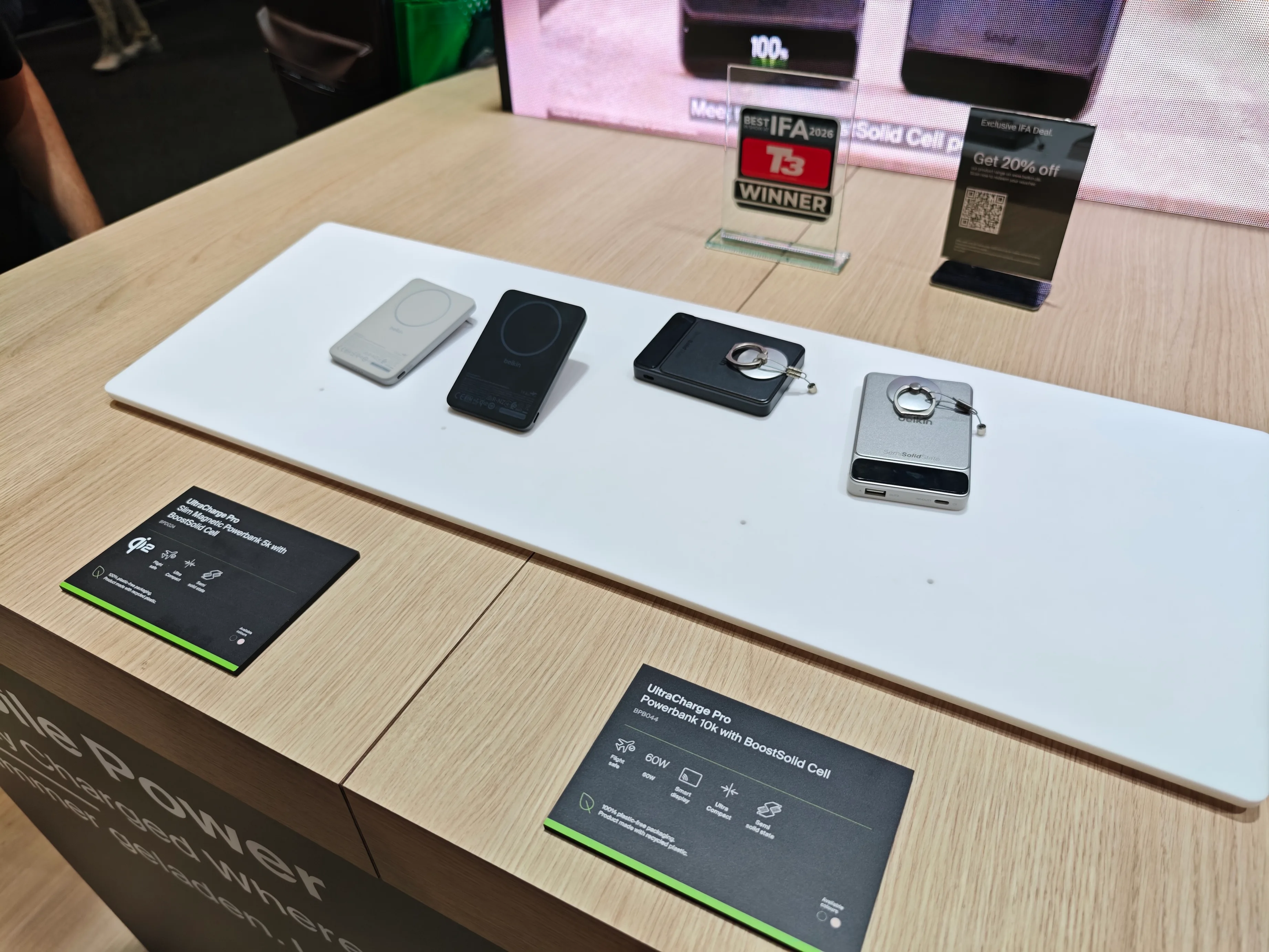
Image Credit: LeiTech IFA Reporting Team
The UltraCharge Pro Power Bank 10K takes a different approach: capacity increases to 10,000mAh, with support for up to 60W output and dual USB-C plus one USB-A ports—still more compact than traditional power banks of equivalent capacity.
The breakthrough lies in the cell chemistry. Conventional lithium-ion batteries rely on liquid electrolytes; semi-solid-state batteries replace part of that liquid with gels or other semi-solid materials. Belkin states that BoostSolid improves energy density, reduces overheating risks, extends cycle life, and retains approximately 80% of original capacity after 1,000 charge cycles.
Over the past few years, “solid-state batteries” have become an almost overused concept across consumer electronics—from smartphones to EVs—recurring regularly in headlines yet progressing slowly toward mass-market adoption.
The semi-solid-state route is far more pragmatic. It avoids the leap to fully solid-state cells while still leveraging benefits like higher energy density, improved safety, and better longevity to enhance current consumer electronics.
Power banks may prove to be an ideal initial application scenario.
Consumers’ most direct demands for power banks boil down to higher capacity, smaller size, enhanced safety, and longer lifespan. While GaN technology solved the size challenge for wall chargers, power banks remained constrained by battery chemistry itself. Once a 10,000mAh unit reaches a certain minimum thickness, shaving off every additional millimeter becomes exponentially harder.
That’s precisely why Belkin’s 8.8mm-thin, 5,000mAh magnetic power bank warrants more attention than many 120W or 140W chargers.
Even Vention—a brand less familiar to domestic Chinese consumers—introduced its H Series 5,000mAh power bank (non-magnetic) at IFA, utilizing hybrid solid-liquid electrolyte cells and achieving an ultra-thin 6.9mm profile.
We must note, however, that semi-solid-state technology still requires time for broader validation. If issues around scale, cost, and real-world longevity can be gradually resolved, future power bank upgrades will become even more compelling. With identical capacity, they’ll get thinner; with identical dimensions, they’ll pack more capacity.
Final Thoughts
Liquid-cooled power banks still carry some demonstration-of-technical-prowess appeal; how deeply “smart charging” evolves depends heavily on device ecosystems; and semi-solid-state batteries still need to prove themselves on cost, safety, and long-term durability.
Yet collectively, they’ve reintroduced several promising avenues for iteration into a product category long considered highly mature—even somewhat stagnant. That’s precisely where IFA’s greatest value lies.
For consumers, the integration and refinement of thermal management, intelligence, and semi-solid-state technologies into charging products will almost certainly elevate our overall charging experience. The sole remaining question is how pricing will evolve—and whether those improvements justify the cost.
Only time—and wider product availability—will tell.
From September 4–8, the world’s largest home appliance and consumer electronics show, IFA 2026, is taking place in Berlin.
As the “most influential new media outlet covering IFA” globally—widely recognized for its AI-focused reporting—LeiTech has deployed its largest and highest-caliber reporting team ever to Berlin. Adopting a “2+N” model (two live hosts + multiple on-site editors + multiple remote editors), LeiTech is delivering comprehensive, immersive, and first-hand coverage of IFA 2026—focusing on AI Agents integrated with home appliances and hardware, robotics converging with domestic living environments, emerging digital lifestyle trends across people, vehicles, and homes, and Chinese brands’ global presence.
The LeiTech IFA 2026 Reporting Team is currently conducting intensive on-the-ground coverage in Berlin—stay tuned!